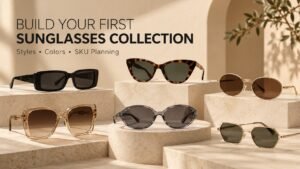
Launching your first sunglasses collection is not about offering as many designs as possible. It is about selecting the right combination of styles, colors, materials and quantities for your target customers while keeping inventory manageable.
For a new eyewear brand, a carefully planned collection of three or four styles may be more practical than launching ten different designs without knowing which ones customers will buy.
The best starting point is to identify your target audience, build a focused product range, limit unnecessary color variations and test demand before expanding production.
This guide explains how to plan your first sunglasses collection, from choosing frames and lens colors to calculating SKUs, managing your budget and preparing for future reorders.
1. Start With Your Target Customer, Not the Trend
One of the most common mistakes new eyewear brands make is choosing products based entirely on popular designs.
A particular frame may perform well on social media, but that does not necessarily mean it will sell successfully in your market.
Before selecting sunglasses for your collection, define who your customers are and why they would purchase your products.
Identify Your Primary Customer Group
Consider four important factors:
Customer demographics
Are you targeting younger fashion-conscious consumers, working professionals, outdoor enthusiasts or customers who prefer classic eyewear?
Different groups have different expectations regarding frame shapes, colors, comfort and price.
Retail price positioning
A customer shopping for $20 fashion sunglasses may prioritize appearance and affordability.
Someone purchasing $100 premium sunglasses may pay more attention to material quality, frame finishing, lens performance and brand identity.
Your intended retail price should influence your material and manufacturing decisions from the beginning.
Sales channels
Where will customers purchase your products?
- Online stores often depend heavily on product photography, clear specifications and recognizable designs.
- Independent boutiques may prefer distinctive collections with consistent brand aesthetics.
- Outdoor retailers may prioritize lens performance, comfort and secure fit.
- Fashion accessory stores may favor accessible prices and frequently refreshed designs.
- The same sunglasses collection may not perform equally well across all these channels.
Geographic market
Consumer preferences can vary by region.
Climate, local fashion, purchasing power, retail competition and seasonal demand should all be considered.
For example, a collection developed for a premium European boutique may require a different product mix from sunglasses intended for a price-sensitive tropical retail market.
Rather than assuming one style is universally popular, examine the products already sold by successful retailers serving your intended customers.
Create a Simple Customer Profile
Before contacting a manufacturer, prepare a short description of your ideal customer.
For example:
- Target market: United States
- Customer: Women aged 22–35
- Sales channel: Direct-to-consumer online store
- Retail positioning: $35–$60
- Product direction: Minimalist, everyday fashion sunglasses
- Preferred aesthetic: Black, tortoiseshell and neutral colors
This information gives your supplier a clearer basis for recommending suitable styles and materials.
It also helps prevent unnecessary product development.
2. Choose the Right Sunglasses Styles for Your First Collection
A successful first collection needs variety, but not unlimited variety.
The goal is to offer customers meaningful choices without creating too many products to manage.
For most emerging fashion eyewear brands, it is useful to divide the collection into three categories.
Core Styles: The Foundation of Your Collection
Core styles should reflect your brand identity while remaining suitable for regular everyday wear.
Possible options include:
Rectangle Sunglasses
Rectangle sunglasses can work well for minimalist, retro and contemporary fashion collections.
They can be developed in narrow, medium or oversized proportions depending on the intended customer.
Oval Sunglasses
Oval frames provide a softer appearance and can complement vintage-inspired or fashion-focused collections.
Metal and acetate versions offer different visual identities and retail positioning.
Classic Square Sunglasses
Square frames provide a recognizable structure that can work across various casual and premium collections.
They are particularly useful when a brand wants a relatively timeless product direction.
Instead of including all three automatically, choose the shapes that best match your customers and brand concept.

Statement Styles: Build Brand Recognition
Statement sunglasses create a stronger visual identity.
These may include:
- Bold cat-eye frames
- Oversized shield sunglasses
- Geometric acetate designs
- Distinctive wraparound sunglasses
- Unusual lens shapes or frame colors
These styles may be particularly useful in social media campaigns and brand photography.
However, they should not dominate your first order unless you have evidence that customers want them.
A visually interesting product is not automatically a commercially successful product.
Functional Styles: Match a Specific Lifestyle
Some eyewear brands focus on activities rather than fashion alone.
For example, an outdoor-oriented brand may consider:
- Wraparound frames for greater coverage
- Lightweight TR90 frames for active wear
- Polarized lenses for glare-intensive environments
- Secure nose pads and temple tips for improved fit
Functional products require additional attention to lens specifications, wearing comfort and intended use.
If your brand primarily sells fashion sunglasses, you may not need a dedicated sports model in the first collection.
The practical recommendation is to begin with two core styles and one carefully selected statement or functional style.
This provides variety while keeping purchasing decisions relatively simple.
Explore different frame structures in the Jioneyewear sunglasses collection.

3. How Many Frame and Lens Colors Should You Offer?
Frame and lens colors are essential to a sunglasses collection, but they are also one of the easiest ways to increase inventory complexity.
Every additional color combination may become another SKU that requires purchasing, photography, storage and individual sales tracking.
Start With Commercial Colors
For many fashion-oriented collections, neutral colors are a practical starting point.
Common options include:
Black
Black frames are versatile and can fit various contemporary and classic styles.
Tortoiseshell
Tortoiseshell offers additional visual depth and works particularly well with many acetate-inspired designs.
Brown and Champagne
Warm neutral colors can support a softer or more premium visual identity.
Transparent Gray
Transparent and translucent colors may suit minimalist or contemporary eyewear brands.
These are useful starting options, not guaranteed bestsellers. Their suitability should be checked against your target customers.
Introduce Trend Colors Selectively
Fashion colors can help differentiate a new brand, but launching too many experimental colors creates unnecessary inventory exposure.
Instead of producing five colors for every frame, consider offering one commercially familiar color and one distinctive color for selected styles.
For example:
Frame Style | Core Color | Secondary Color |
Rectangle | Black | Transparent Gray |
Oval | Tortoiseshell | Champagne |
Cat-Eye | Black | Dark Burgundy |
This creates six different SKUs from three frame styles.
The exact colors should be chosen according to the brand aesthetic, customer preferences and available manufacturing options.
Coordinate Frame and Lens Colors
A sunglasses collection should also consider how frame colors interact with lens tints.
Possible combinations include:
- Black frame with gray lenses
- Tortoiseshell frame with brown lenses
- Champagne frame with brown gradient lenses
- Gunmetal frame with green lenses
These combinations can create different visual effects without necessarily requiring entirely new frame designs.
However, lens appearance is only one consideration.
Lens color, darkness, UV protection and polarization are separate specifications.
A dark lens does not automatically provide adequate UV protection, and polarized lenses do not automatically meet every UV protection requirement.
Confirm the intended lens performance, applicable testing requirements and target-market regulations with your manufacturer.
For a first collection, maintaining consistent lens quality across a small number of colorways is usually more valuable than introducing numerous decorative finishes.

4. Plan Your First Sunglasses SKUs Without Overordering
SKU planning is one of the most important parts of developing a new eyewear collection.
An SKU, or Stock Keeping Unit, represents a distinct product variation that needs to be tracked separately.
For sunglasses, changing the frame color, lens specification or another inventory-defining feature can create a new SKU.
How to Calculate Your Sunglasses SKUs
The basic calculation is:
Number of Styles × Number of Color Combinations = Total SKUs
For example:
3 styles × 2 colors = 6 SKUs
If you introduce five styles with four color combinations each, your collection immediately grows to 20 SKUs.
A larger collection is not necessarily better, particularly when you have no previous sales data.
Example: A 300-Pair Starter Collection
Consider a hypothetical startup brand launching three sunglasses styles.
Style | Color Options | Quantity per Color | Total Pairs |
Rectangle | 2 | 50 | 100 |
Oval | 2 | 50 | 100 |
Cat-Eye | 2 | 50 | 100 |
Total | 6 SKUs |
| 300 |
This example creates six product variations with a total inventory of 300 pairs.
Important: This is a planning illustration, not a guaranteed manufacturing MOQ. A 50-piece quantity per color is only feasible when the supplier confirms that the selected existing styles, colors and branding requirements qualify for that order structure.
Custom frame development, special colors, new tooling and different materials may require significantly larger minimum quantities.
The actual order plan must be adjusted to the supplier’s quotation.

Understand the Difference Between Existing Styles and Fully Custom Designs
New brands sometimes assume that low MOQ applies to every level of customization.
In reality, the production requirements can differ considerably.
Existing frame designs
Selecting a standard frame from an existing collection may reduce tooling costs and allow more flexible trial orders, depending on available inventory and manufacturing arrangements.
Existing frames with customized branding
Adding your logo, packaging or selected lens options may require additional minimum quantities and setup costs.
Fully customized frame designs
Developing a new frame shape, mold, structure or exclusive material combination usually requires a greater commitment.
Before requesting a quotation, confirm whether the MOQ applies per style, per color or to the overall order.
For a more detailed explanation, see our Low MOQ Custom Eyewear Manufacturing Guide.
A Better Way to Control SKU Complexity
Instead of immediately expanding your collection, consider three questions:
- Does this new SKU attract a different customer or satisfy a different preference?
- Is there enough expected demand to justify the minimum order quantity?
- Can the business support the additional inventory, photography and marketing costs?
If two styles are extremely similar, launching both may divide sales rather than create meaningful additional demand.
A focused assortment makes it easier to identify what customers actually want.
5. Balance Product Quality, Retail Price and Budget
Choosing sunglasses for your first collection is not simply a matter of finding the lowest factory price.
The correct product specification should support your intended retail price, brand positioning and customer expectations.
Choose Frame Materials According to Your Market
Different materials suit different commercial objectives.
Frame Material | Main Characteristics | Potential Positioning |
PC | Lightweight, economical and suitable for molded designs | Affordable fashion collections |
TR90 | Flexible and lightweight | Active lifestyle and comfort-focused collections |
Acetate | Rich material appearance and polished finishing | Premium fashion and boutique collections |
Metal | Slim structures and varied surface finishes | Classic, minimalist and contemporary collections |
Material alone does not determine product quality.
Hinge construction, frame alignment, surface finishing, lens installation and manufacturing consistency are equally important.

Select Lens Specifications Based on Intended Use
For everyday fashion sunglasses, brands may prioritize visual appearance, comfort and verified UV protection.
For driving or outdoor-oriented collections, polarized lenses may be worth considering because they can reduce glare from reflective surfaces.
Sports-oriented products may require additional attention to lens material, frame coverage and secure fit.
Avoid adding premium features simply because they sound attractive.
Every feature should support a clear customer benefit and a retail price that customers are willing to pay.
Calculate Your Actual Landed Cost
The factory quotation is only one part of your overall product cost.
Your landed cost calculation should consider:
- Sunglasses production
- Logo customization
- Packaging and accessories
- Quality inspection and applicable testing
- International transportation
- Import duties and other relevant import charges
- Any additional costs required to bring the goods into saleable inventory
For example, suppose a pair of sunglasses has a landed cost of $8 and sells for $32.
Gross profit per pair would be:
$32 − $8 = $24
Gross margin would be:
($24 ÷ $32) × 100 = 75%
This is an illustrative calculation, not a typical or guaranteed eyewear margin.
It also does not account for marketing expenses, payment processing, fulfillment to the customer, returns and operating overhead.
A collection with attractive gross margins can still be unprofitable if customer acquisition costs are too high or inventory sells too slowly.
Allocate Your Budget Beyond Inventory
A first collection needs funding for more than manufacturing.
Remember to reserve capital for:
- Product samples and revisions
- Packaging design
- Product photography
- Website development
- Marketing and customer acquisition
- Returns and after-sales service
- Potential future reorders
Spending the entire launch budget on inventory may leave insufficient resources to actually sell it.
6. Test Your Sunglasses Collection Before Scaling Production
Even a carefully researched collection contains uncertainty.
What looks attractive in a digital rendering may feel different when customers wear it.
That is why physical sample evaluation should happen before bulk production.
Evaluate Samples From the Customer’s Perspective
When reviewing samples, focus on more than appearance.
Frame fit
Check frame width, temple length, bridge fit and how the sunglasses sit on different faces within your target customer group.
Wearing comfort
Consider frame weight, contact pressure and stability during ordinary use.
Lens experience
Review visibility, color perception, optical quality and the specified lens functions.
Manufacturing consistency
Check hinges, alignment, polishing, coating quality and lens installation.
Brand presentation
Evaluate logo placement, packaging appearance and whether the finished product matches your brand identity.
A premium-looking photograph cannot compensate for uncomfortable frames or inconsistent finishing.
Collect Feedback Before Committing to Larger Quantities
If possible, present physical samples to a small group of potential customers.
Ask questions such as:
- Which style would you most likely purchase?
- Which color would you choose?
- Does the frame feel comfortable?
- What would you expect to pay?
- What would prevent you from purchasing this product?
Avoid relying only on compliments.
A customer saying that a frame looks attractive is different from demonstrating willingness to buy it at your intended retail price.
You can also use small retail trials, preorders or limited releases to understand interest, provided the expected delivery terms are clearly communicated.
For brands using existing designs, a small confirmed-MOQ test order may provide useful information before introducing deeper customization.
Use Sample Approval to Reduce Production Problems
Before production begins, confirm the approved sample and written specifications.
These should include frame dimensions, colors, lens materials, functions, logos, packaging and agreed quality requirements.
Do not approve a product based only on a photo when fit, finish or lens performance is important.
A properly documented sample helps establish what the manufacturer is expected to deliver.
For more information about customization and production planning, read our Private Label Sunglasses Manufacturing Guide.
7. Use Early Sales Data to Plan Your Next Order
Your first collection should be treated as the beginning of a product development process rather than a final assortment.
Once products enter the market, actual customer behavior becomes more valuable than assumptions.
Track Sales at the SKU Level
Do not only measure the total number of sunglasses sold.
Monitor individual styles and colors.
Useful indicators include:
Sell-through rate
The percentage of available inventory sold during a defined period.
For example, selling 40 pairs from an initial 50-pair SKU represents an 80% sell-through rate for that period, assuming no additional receipts or stock adjustments.
Sales velocity
How quickly each SKU sells over time.
Gross margin
The relationship between the selling price and product cost.
Return rate
The percentage of sold products returned by customers, including the reasons for those returns.
Customer feedback
Recurring comments about fit, frame shape, lens quality or appearance.
Together, these indicators help you identify products worth replenishing and those requiring changes.
Review Your Collection After 30, 60 and 90 Days
A new brand can use a structured review schedule, adjusted for its own sales volume and seasonality.
After 30 days
Review early customer feedback, product-page engagement, conversion and initial purchases.
After 60 days
Compare sales performance between styles and colors. Identify which products are gaining consistent demand.
After 90 days
Evaluate sell-through, remaining stock, return rates and whether particular SKUs justify reordering.
These periods are planning checkpoints rather than universal performance benchmarks.
A product with slow early sales may need better presentation, pricing or customer targeting rather than immediate discontinuation.
Plan Reorders Before Your Bestsellers Run Out
Production and international shipping require time.
Waiting until a popular SKU is completely sold out can lead to missed sales opportunities.
A simplified reorder-point calculation is:
Average Daily Sales × Replenishment Lead Time + Safety Stock
For example, if a product sells three pairs per day, replenishment takes 40 days and your chosen safety stock is 30 pairs:
3 × 40 + 30 = 150 pairs
You would aim to trigger a reorder when your inventory position reaches approximately 150 pairs.
The actual calculation should account for demand changes, open purchase orders, available inventory and seasonal fluctuations.
For a growing brand, reliable replenishment is often more valuable than continually adding new designs.
8. First Sunglasses Collection: Buyer Checklist
Before placing your first wholesale sunglasses order, use this checklist to confirm that your collection is commercially and operationally ready.
Planning Area | What to Confirm |
Target Market | Country, customer group and sales channel |
Retail Positioning | Expected retail price and brand identity |
Frame Selection | Core styles and statement or functional styles |
Color Planning | Main colors and limited experimental options |
SKU Structure | Total number of styles and color combinations |
Order Quantity | Confirmed MOQ per style, color and order |
Frame Materials | PC, TR90, acetate, metal or other specified materials |
Lens Requirements | Material, tint, UV protection and other required functions |
Branding | Logo method, artwork and packaging |
Compliance | Applicable product requirements, testing and documentation |
Samples | Approved physical samples and specifications |
Budget | Landed cost, marketing funds and reorder reserve |
Launch Schedule | Sampling, production, inspection and delivery dates |
Inventory Planning | SKU tracking, performance reviews and reorder process |
This checklist can also serve as a starting point for discussions with your manufacturer.
Providing detailed requirements early can reduce unnecessary quotation revisions and help suppliers recommend more suitable production options.
Frequently Asked Questions
1. How many sunglasses styles should a new brand launch with?
For a small, untested fashion brand, two to four carefully selected styles can be a reasonable starting point.
The right number depends on available capital, supplier MOQs, target customers and how much variety the brand needs.
It is usually better to test a focused assortment than to introduce numerous similar designs without demand evidence.
2. How many color options should each sunglasses style have?
One or two color combinations per style can help control the number of SKUs in an initial collection.
Brands with stronger demand evidence may justify additional colors.
Every new combination should serve a clear customer preference rather than simply expanding the catalog.
3. Should I use acetate or PC for my first sunglasses collection?
The decision depends on your desired retail positioning and budget.
PC may be suitable for cost-conscious fashion programs, particularly when an existing mold is available.
Acetate may be appropriate for brands seeking richer material appearance and premium finishing.
Compare actual samples, supplier MOQs, manufacturing costs and expected retail prices before deciding.
4. Can I start a private label sunglasses brand with a small order?
Yes, in some cases.
Existing catalog designs may offer more flexible purchasing options than fully customized frames.
However, minimum quantities depend on material, color availability, branding requirements and manufacturing arrangements.
Confirm the exact MOQ for each selected product before building your purchasing plan.
5. When should I expand my sunglasses collection?
Expansion is more justified when your existing products show consistent demand and you understand which customers, styles and colors generate profitable sales.
Before adding new designs, consider whether replenishing successful SKUs would produce a better result.
Build a Sunglasses Collection That Can Grow With Your Brand
A successful sunglasses collection does not need to start with dozens of designs.
For emerging eyewear brands, the more practical approach is to understand the target market, select a focused range of frames, control unnecessary color variations and build a purchasing plan around realistic order quantities.
The first collection should give your business enough variety to attract customers while generating useful information about what actually sells.
As demand becomes clearer, you can introduce additional colors, improve product specifications and develop more distinctive designs with greater confidence.
Start Planning Your First Collection With Jioneyewear
At Jioneyewear, we work with emerging eyewear brands, independent designers and wholesale buyers who want to develop collections suited to their target markets.
Our support includes sunglasses style selection, material recommendations, OEM/ODM customization, private label branding and manufacturing planning.
Whether you are choosing from existing sunglasses models or developing an original design, we can help you evaluate product specifications, customization options and suitable order quantities.
Tell us your target country, customer profile, preferred styles, retail price range and estimated purchasing quantity.
Our team can help you review practical options for building your first sunglasses collection.