
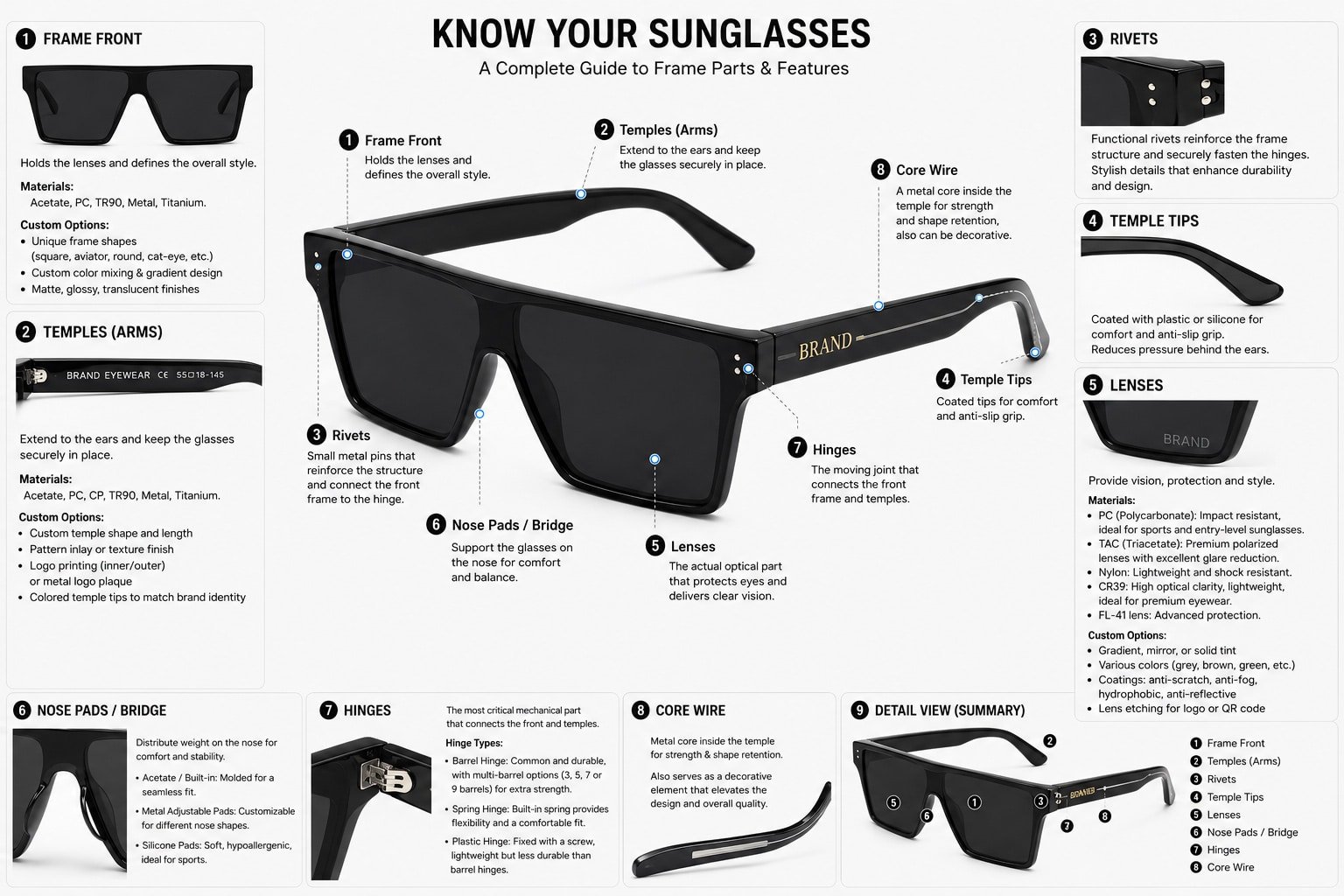
Eyewear OEM & ODM Customization: Complete Technical & Sourcing Guide
For professional eyewear brand owners, importers, and large-scale distributors, managing a successful private label launch requires precise structural specification. Eyewear production is not uniform; every individual component—from the base polymer chemistry to the barrel count inside a mechanical hinge—directly impacts your landed cost, retail returns, and brand reputation.
This technical guide breaks down the full anatomy of an optical frame or pair of sunglasses, detailing the explicit eyewear OEM ODM customization options, manufacturing processes, and quality control thresholds available for your brand.
Part-by-Part Component Customization Matrix
1. Front Frame Structure & Base Geometry
The front frame serves as the core load-bearing architecture of the glasses, securing the lenses and dictating the face-fit ergonomics.

The architectural styles adapt to classic aviators, bold cat-eyes, minimalist rounds, and retro rectangles. Your selection determines both the assembly method and the base material requirements.
PC (Polycarbonate): High impact resistance, making it suitable for high-volume promotional or fast-fashion lines.
TR90: High flexibility and memory retention, lowering structural breakage rates in sports and kids’ collections.
Acetate (Cellulose Acetate): A high-grade material shaped via CNC milling. It yields rich color depth and deep patterns without using topical paints.
Metals (Monel, Stainless Steel, Titanium): Delivers thin profiles, lightweight structures, and excellent structural durability.
OEM/ODM Customization Options:
Dimensional Adjustments: Modify bridge widths and lens pocket depths to produce “Regional version” profiles, resolving slippage complaints in specific regional demographics.
Structural Molds: Develop custom injection molds for PC or TR90 frames based on proprietary CAD drawings.
Acetate Block Lamination: Layer different sheets of acetate to produce contrasting inner-and-outer frame colors or gradient structural patterns.
2. Temples (Frame Arms) & Dimensional Control
Temples run from the front frame endpieces over the wearer’s ears, balancing the frame’s weight distribution. Crucial frame measurements (lens width, bridge width, and temple length) are typically etched directly onto the inner temple surface for optical tracing.
OEM/ODM Customization Options:
Length & Ergonomics: Adjust temple lengths (e.g., from 140mm to 145mm or 150mm) to fit your target market’s sizing profiles.
Aesthetic Inlays: Insert specialized metal details or custom textures directly into the temple profiles during production.
Branding Adjustments: Add brand emblems using high-precision laser work, metal plaques, or inner pad printing.
3. Hinges & Rivets: Mechanical Joints

Hinges act as the structural joint connecting the front frame to the temples, directly handling daily folding stress.
Barrel Hinges (Interlocking joints): Built using interlocking metal teeth secured with a centralized screw. Available in 3-barrel, 5-barrel, 7-barrel, or 9-barrel configurations. More barrels increase structural stability and prevent temple misalignment.
Spring Hinges: Feature an integrated internal spring mechanism that allows temples to flex outward past 90 degrees. This design accommodates wider face profiles and reduces side-head pressure for online buyers.
Plastic Hinges: Molded directly out of the frame material using a single anchor screw. This style is economical but lacks the long-term structural alignment of metal hinges.
Rivets serve as the visible exterior hardware on the frame front and temples. In standard production, they may be decorative placeholders. However, premium acetate manufacturing uses functional rivets drilled completely through the sheet to anchor the hinge plates directly to the frame wall.
OEM/ODM Customization Options:
Hardware Matching: Choose specific barrel counts (e.g., 5-barrel or 7-barrel) to align with your collection’s durability goals and price points.
Rivet Geometries: Select custom exterior rivet shapes, such as standard double-dots, vintage shields, stars, or custom geometric diamonds.
4. Wire Cores (Internal Temple Pins)

A wire core is a structural metal rod pressed directly into the center of acetate temples. This component provides the rigidity needed for the material to hold its shape over time. Without an internal wire core, acetate arms naturally warp when exposed to ambient heat, requiring constant adjustments. It also allows opticians to apply localized heat and bend the temples to custom fits.
OEM/ODM Customization Options:
Filigree Engraving: Laser-etch patterns onto the metal core wire, making them visible through crystal or transparent acetate sheets.
Plating Finishes: Specify raw gold, silver, gunmetal, or rose gold electroplating on the wire core to create contrast within the temple.
5. Nose Pads & Temple Tips (Touchpoint Components)
Nose pads distribute the frame’s weight across the nasal bridge to prevent slippage. Acetate and plastic frames generally use integrated, molded nose pads. Metal frames use adjustable metal pad arms with screw-in or clip-on pads. Sports designs often feature soft silicone or rubber compounds for secure grip during movement.
Temple tips (ear socks) are protective sleeves slipped over the ends of metal temples. They shield the skin from prolonged metal contact, reducing irritation and helping to avoid nickel allergy reactions.
OEM/ODM Customization Options:
Material Selection: Choose between hard PVC, ultra-soft silicone, solid titanium, or color-matched acetate components.
Branding Applications: Embed custom metal logo inserts directly into translucent silicone nose pads.
Dual-Injection Tips: Use contrasting color combinations or non-slip textures to match your brand’s color palette.
6. Lenses: Optical Performance & Coating Systems

The lens determines the optical safety and visual performance of the final product. Matching the right lens material to your target market’s specific application keeps quality high and prevents returns.
AC (Acrylic): Light and cost-effective, making it useful for entry-level fashion sunglasses or fast-turn promotional projects.
PC (Polycarbonate): Highly impact-resistant, making it standard for protective safety gear, children’s eyewear, and sports lines.
TAC Polarized: A layered lens design that filters horizontal glare from surfaces like water, snow, and roads. This option increases outdoor visual comfort for driving and fishing lines.
CR39: Features high optical clarity and excellent scratch resistance at half the weight of traditional glass, making it popular for premium optical collections.
Nylon: Offers excellent structural flexibility and crack resistance, making it useful for rimless and high-wrap sports designs.
FL-41 Tint: A specialized therapeutic lens tint engineered to filter specific light wavelengths, helping users manage light sensitivity and migraines.
OEM/ODM Customization Options:
Tint Customization: Choose solid tints, gradient transitions, or reflective mirror coatings across different colors.
Performance Coatings: Apply hydrophobic anti-fog, oleophobic anti-smudge, anti-scratch hard coats, or specialized blue-light filtering layers.
Corner Logo Etching: Laser-etch clean brand logos or small QR codes into the top corner of the lens without obstructing the wearer’s line of sight.
Manufacturing Process Analysis: Plastic Injection vs. Acetate CNC
Choosing between injection molding and CNC cutting changes your tooling costs, manufacturing time, and minimum order requirements.
Plastic Injection Molding (PC, TR90, CP)
Production Logic: Raw polymer pellets are melted and injected under high pressure into steel molds. Once cooled, the frames are trimmed, tumbled, painted with base and clear coats, and assembled.
MOQ: Depends on the mold and the shape of the glasses.
Tooling Cost: Custom shapes require new steel molds, with each mold costing anywhere from several hundred to several thousand US dollars.
Lead Time: Under the premise of existing molds, the production lead time is approximately 15-25 days.
Handmade Acetate (CNC Milling)
Production Logic: Solid sheets of pre-cured cellulose acetate are cut using precision CNC routers. The components then go through multi-day tumbling stages, manual polishing, core-wire insertion, and custom heat shaping.
MOQ: Evaluated case-by-case based on block material availability.
Tooling Cost: RMB 0 for standard molding, as shapes are driven by digital CNC code rather than physical injection molds.
Lead Time: 75 to 90 days, due to the extensive manual tumbling, polishing, and precise heat-shaping steps.
Brand Logo Customization Options

We offer seven commercial logo techniques across different frame materials and positions:
Pad Printing / Silk-Screening: Applies durable inks to flat or curved surfaces. Best for inner temple model numbers and text.
Laser Engraving: Uses targeted laser beams to cut sharp, permanent logos directly into metal or dark acetate layers.
Hot Stamping: Presses metallic foils onto acetate surfaces using heat and pressure, leaving clean gold or silver finishes.
Metal Logo Inlays: Mills small pockets directly into the acetate temple, flushing custom-stamped metal pieces into the frame for a clean look.
In-Mold Embossing: Cuts logos directly into the steel tooling wall so plastic components emerge with raised or recessed branding.
Epoxy Dome Labels: Places dimensional, color-filled resin graphics onto endpiece accents or specialized temple tips.
Lens Etching: Applies low-contrast laser marks to the upper edges of lens surfaces for clean brand styling.
Quick Buyer Decision Guide
Best for: Growing brands, online private labels, and optical wholesalers who need specific material control, steady quality, and clear logo placement to build long-term repeat orders.
Not ideal for: Buyers searching for off-the-shelf, low-cost promotional stock pieces with zero modification options.
MOQ consideration: Using existing factory molds keeps MOQs lower. Fully custom frame profiles require investment in new injection tooling or a longer acetate CNC timeline.
Customization potential: Every single structural detail—including base polymers, core wire filigrees, hinge styles, lens materials, and custom packaging—can be tailored to your requirements.
Key point to confirm before ordering: Check the specific compliance documents required by your destination market, such as FDA impact resistance testing for PC lenses or CE declarations for optical frames.
Pre-Shipment Quality Control Checklist
To minimize retail return rates and protect your brand’s reviews, all orders go through a systematic pre-shipment inspection:
Frame Alignment: Frames are checked flat on surface plates to make sure temples are perfectly parallel and aligned.
Hinge Movement: Hinge friction is tested to ensure smooth opening and closing without looseness or binding.
Lens Fit: Lenses are checked for proper groove tension to eliminate rattling, edge chipping, or high assembly stress.
Surface Finish: The frame surface is checked under clean lighting to verify uniform paint coverage and catch any pitting, bubbles, or scratches.
Logo Accuracy: Logo print crispness, centering, symmetry, and adhesion are verified against your vector files..
The Sourcing & Production Process
Requirement Profiling: Submit your vector logos (.AI/.PDF), target price targets, and desired material specifications.
Engineering Assessment: Our team reviews your design files and generates technical drawings along with component options.
Prototyping Stage: Physical pre-production samples are created to verify exact colors, fitment, and logo placement.
Sample Evaluation: Your team evaluates the physical prototype and provides formal written approval.
Mass Production: Raw materials are prepared, and CNC cutting or injection molding begins following the approved sample.
QC Inspection & Delivery: Final quality checks are conducted, products are packed into custom boxes, and shipment is arranged.
Eyewear Manufacturing FAQ
Q1: Can I add my brand logo to a custom frame style without paying mold fees?
A: Yes. If you choose handmade acetate manufacturing, frames are cut using CNC milling machines guided by software files. This lets you customize the frame shapes without paying for injection molds. Alternatively, you can print your logo onto our existing inventory of injection-molded frames to avoid tooling costs entirely.
Q2: Why do similar-looking eyewear frames have vastly different wholesale quotes?
A: Prices vary because of differences below the surface: whether the factory uses fresh raw materials or recycled scraps, the number of coats of paint applied, the lens material and coating grades, and the strictness of the final quality check. Lowering costs too far often results in higher scratch rates, peeling paint, and customer returns.
Q3: What is the typical turnaround time for a custom eyewear production run?
A: For injection-molded plastic styles using existing factory tooling, mass production typically takes around 15 to 25 days. For custom handmade acetate orders, the extensive CNC routing, long tumbling stages, and manual polishing steps require a production timeline of 75 to 90 days.
Q4: Are polarized functions and UV400 protection the same thing?
A: No, they serve different purposes. UV400 coatings block harmful ultraviolet rays to protect the eyes from sun damage. Polarized functions use a specialized filter layer to block horizontal reflections and glare from surfaces like wet roads or water. For outdoor or driving lines, we recommend specifying both features on your lenses.
Start Your Eyewear OEM/ODM Project
Protect your brand from quality complaints, high return rates, and bad online reviews. Send us your target market details, required order quantities, and vector logo files. Our engineering team will provide a detailed quote covering material options, tooling requirements, and sample production schedules.