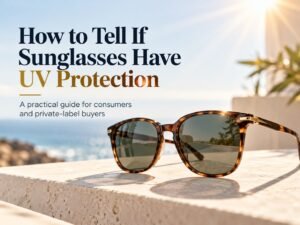
Wondering how to tell if sunglasses have UV protection? Start with a label stating UV400 or 100% UVA/UVB protection. For stronger assurance, ask an optician to test the lenses with a UV meter.
Dark lenses, expensive frames and polarized filters cannot prove UV protection. Only appropriate optical measurements can establish how much ultraviolet radiation passes through the lenses.
For everyday consumers, understanding labels and getting an optical-shop test is usually enough. For eyewear brands sourcing sunglasses in bulk, the process goes further: confirming laboratory results, matching reports to specific lens designs and checking that production materials meet the approved specifications.
What Does UV400 or 100% UVA/UVB Protection Mean?
Before checking your sunglasses, it helps to understand what UV protection actually measures.
Sunlight contains ultraviolet radiation that is invisible to the human eye. Two types are particularly important when choosing sunglasses:
- UVA: Longer-wavelength ultraviolet radiation extending to approximately 400 nanometers.
- UVB: Shorter-wavelength ultraviolet radiation associated with damage to the eye’s surface and other biological tissues.
Both contribute to UV-related eye damage. According to the U.S. Food and Drug Administration (FDA), consumers should choose sunglasses labeled UV400 or 100% UV protection. Properly performing lenses with these ratings block more than 99% of UVA and UVB radiation.
UV400 Explained
UV400 indicates that the lens is intended to provide ultraviolet protection through wavelengths up to 400 nanometers.
That distinction matters because a lens may block most shorter UV wavelengths while allowing more radiation through near the upper end of the UVA range.
However, a printed UV400 claim does not establish the lens’s measured performance. A supplier still needs suitable testing evidence to support the claim.
Similarly, a statement such as “100% UV blocking” should be interpreted alongside the test method, measurement range and instrument’s detection limits rather than assumed to mean mathematically zero transmission at every wavelength.
UV Protection Is Not the Same as Lens Darkness
A light gray lens can offer excellent UV protection. A nearly black lens may offer inadequate protection if the material lacks effective UV-blocking properties.
That is because visible light transmission and ultraviolet transmission are different optical characteristics.
The same distinction applies to sunglass filter categories. A category 3 lens provides substantial reduction of visible sunlight, but the category number alone is not evidence of a UV400 claim.
For consumers, choose documented UV protection first and tint darkness second.
For brands, specify both UV performance and visible light transmission when developing a sunglass collection.

What Can a Label Tell You, and What Can It Not Prove?
When shopping for sunglasses, the first practical step is to examine the product label, packaging or manufacturer’s specifications.
Look for clear protection claims rather than general marketing language such as “sun protection,” “premium lenses” or “high-quality polarized sunglasses.”
Common Sunglasses Labels Explained
Label or feature | What it tells you | What it cannot prove |
UV400 | Claims UV protection extending to 400 nm | That the actual lenses passed a suitable test |
100% UVA/UVB | Claims protection against both UV bands | That every production batch matches the claim |
Polarized | Indicates a filter designed to reduce reflected glare | UV protection by itself |
Category 3 | Describes visible-light filtering for bright conditions | A specific UV400 performance level |
Mirrored lenses | Describes a reflective surface treatment | How much UV radiation is blocked |
Dark tint | Indicates reduced visible brightness | UV absorption or transmission |
The American Academy of Ophthalmology confirms that darker, mirrored and polarized lenses do not automatically provide better UV protection.
Why Polarized Sunglasses Still Need UV Testing
Polarization and UV blocking solve different problems.
Polarized filters reduce certain reflected light, particularly glare from roads and water. UV-blocking materials or treatments reduce ultraviolet transmission.
A polarized lens may incorporate both functions, but polarization alone does not demonstrate UV protection.
For example, a private-label brand developing driving sunglasses may request TAC polarized lenses with UV400 protection.
Can You Trust Sunglasses Without a UV Label?
An absent label does not necessarily mean the lenses provide no UV protection. Some unlabeled lenses may still block substantial UV radiation.
The problem is uncertainty.
If the manufacturer cannot identify the lens specifications, consumers should request an optical-shop test before relying on the sunglasses for sun protection.
For bulk buyers, an unidentified or unsupported UV claim is a reason to pause sample approval until suitable technical evidence is available.

How Can an Optician or Laboratory Test UV Protection?
A professional UV test measures ultraviolet light passing through a lens rather than judging its appearance.
There are two practical levels of verification: optical-shop screening and laboratory measurement.
1. Optical-Shop UV Testing
Many opticians and optical retailers have UV photometers or transmission meters designed for checking sunglass lenses.
A typical screening procedure involves:
- Confirming that the instrument is suitable for the relevant UV wavelengths and is functioning correctly.
- Positioning one sunglass lens at the measurement area.
- Taking a UV transmission or blocking measurement.
- Repeating the procedure for the second lens.
- Interpreting the result according to the instrument’s measurement range and specifications.
Some instruments display a UV-blocking percentage; others indicate whether the lens meets a preset screening threshold.
The American Academy of Ophthalmology recommends having uncertain sunglasses checked at an optical shop with a UV meter.
However, not every UV meter measures the full ultraviolet spectrum. A device operating at one wavelength cannot automatically verify performance across all wavelengths up to 400 nm.
Consumers should therefore ask what the instrument measures, particularly when testing unfamiliar or unlabeled sunglasses.
2. Laboratory Spectrophotometer Testing
For eyewear brands, importers and manufacturers, laboratory testing provides more detailed technical evidence.
A suitable UV-visible spectrophotometer measures the proportion of radiation passing through a lens at different wavelengths.
The process generally includes:
Step 1: Identify the sample.
The laboratory records the lens or finished sunglass model, color, material and other relevant identifiers.
Step 2: Prepare the measurement.
The lens is positioned according to the applicable test procedure. Instrument setup, measurement location and calibration affect the reliability of the result.
Step 3: Measure spectral transmittance.
The equipment measures transmission across the specified wavelength range, allowing the laboratory to evaluate UVA and UVB performance.
Step 4: Evaluate the results.
Measured values are compared against the applicable requirements and any additional UV400 claims.
Step 5: Issue the report.
A laboratory report identifies the tested product, methods, results and conclusions.
3. Why a Spectral Test Is More Useful for Bulk Purchasing
An optical-shop screening meter is convenient when checking one pair.
A detailed laboratory report is more useful when a company must approve a product specification for repeat manufacturing.
It can help buyers answer questions that a simple pass indicator may not resolve:
- Does the lens meet the specified UV requirements?
- Which wavelength range was examined?
- Is the result associated with the correct lens color and material?
- Can the report be matched to the approved product?
- Does the result support the exact protection claim planned for packaging?
The most valuable evidence is not a photograph of a meter displaying “PASS.” It is a traceable result that can be connected to the actual product being ordered.

Which At-Home Checks Are Unreliable or Only Indicative?
Online videos often demonstrate quick methods for checking sunglasses UV protection.
Some can reveal possible problems. None should automatically be treated as equivalent to a calibrated professional test.
The UV Flashlight and Banknote Test
One popular method uses a UV flashlight and a fluorescent feature on a banknote or UV-sensitive card.
The idea is straightforward: place a sunglass lens between the UV light source and the fluorescent object, then observe whether the fluorescence becomes weaker.
Reduced fluorescence may indicate that the lens blocks some light emitted by that particular flashlight.
But there is a limitation.
Many UV flashlights operate around a narrow wavelength band, such as 365 nm or 395 nm. A successful demonstration at one wavelength does not prove complete protection throughout the UV spectrum.
The result also depends on light intensity, positioning and the fluorescent material.
This makes the method an informal indicator, not reliable UV400 verification. Never direct UV flashlights toward your eyes.
Other Popular Checks Compared
At-home method | What it may show | Reliability for UV400 |
Looking through dark lenses | Reduction of visible brightness | Not reliable |
Polarized test card | Presence of a polarizing filter | Does not measure UV |
UV flashlight and banknote | Possible blocking at the lamp’s emitted wavelengths | Indicative only |
UV-sensitive beads | Change in UV exposure under particular conditions | Indicative only |
Smartphone camera | Changes in visible image brightness or color | Not reliable |
Comparing cheap and expensive sunglasses | Differences in appearance and construction | Not reliable |
Can You Judge UV Protection by Lens Material?
Materials such as polycarbonate may have useful inherent UV-absorbing properties. Other lens materials can achieve strong protection through additives or coatings.
However, material names alone should not replace verification of the finished lens.
A lens’s actual performance depends on its formulation, construction and any relevant treatments.
For example, switching between different lens suppliers or coating specifications can change the finished product’s optical characteristics.
That is why private-label buyers should verify the actual lens configuration rather than relying solely on material descriptions.

What UV Test Evidence Should a Private-Label Buyer Request?
For consumers, the question is whether one pair provides adequate UV protection.
For eyewear brands, the more important question is whether every approved product specification can be supported with consistent evidence before bulk production.
Suppose you order 1,000 sunglasses across four lens colors.
The supplier provides one UV400 report for a black lens. Does that automatically verify the brown, gradient and mirrored versions?
No.
The report establishes the tested sample’s performance under the stated conditions. Its relevance to other versions must be justified through the material specifications, construction and appropriate testing coverage.
1. Check the Difference Between UV380 and UV400
This is an important specification detail that buyers sometimes overlook.
Some test methods and performance calculations use 380 nm as the upper limit of a defined ultraviolet measurement range.
A commercial UV400 claim extends to 400 nm.
If your marketing or purchase specification promises UV400, ask whether the test evidence covers the additional wavelength region from 380 to 400 nm.
Do not assume a report showing compliance through 380 nm proves an unqualified UV400 claim.
Buyers should have the laboratory confirm the appropriate measurement range and acceptance criteria for their intended claim and market.
2. Confirm Each Relevant Lens Configuration
Different colors, coatings and lens constructions may require separate testing or documented technical justification for grouping.
This is particularly relevant when a collection includes:
- Solid and gradient lenses
- Mirrored and non-mirrored finishes
- Different lens materials
- Different UV-blocking additives or coatings
- Multiple lens suppliers
It does not follow that every color always requires an entirely separate full test report. The appropriate test plan depends on material equivalence, manufacturing changes and the applicable requirements.
The buyer should agree on that plan before production.
3. Link Testing Evidence to the Approved Sample
A strong manufacturing approval process should connect three things:
Approved physical sample → Confirmed lens specification → Supporting test evidence
If the factory later changes the lens supplier, material formulation or relevant coating, ask whether revalidation is necessary.
This is especially important for brands planning repeat orders.
A UV report from an earlier collection is not automatically evidence for a newly developed lens.
4. Separate UV Protection From Other Market Requirements
UV performance is only one part of sunglass product evaluation.
Depending on the destination and intended use, buyers may also need to review visible-light transmission, driving suitability, optical quality, impact resistance, labeling and applicable regulatory documentation.
ISO 12312-1 addresses general-use sunglasses, but its scope does not automatically cover occupational safety eyewear, specialized sports protection or direct solar observation. [3]
Specify the destination market before requesting documentation so the manufacturer can identify the relevant requirements.
5. What a Redacted UV Test Report Should Show
A useful report example should retain technical information while concealing confidential customer details.
A buyer reviewing an anonymized report should still be able to identify the testing laboratory, method, sample configuration, wavelength range and measured results.
Confidential customer names, commercial references and unrelated project information can be hidden.
Do not remove the information necessary to understand which product was tested and whether it passed.
For a real-world example of professional sunglass testing services, the Australian Radiation Protection and Nuclear Safety Agency (ARPANSA) publishes information about testing sunglasses to AS/NZS 1067. [5]
A redacted report is helpful for illustrating the process, but buyers should request the relevant original documentation directly when making purchasing decisions.
6. Ask Jion About UV Testing and Custom Lens Options
At Jion Eyewear, private-label projects can begin with an existing frame design or a customized eyewear concept.
Buyers can explore options involving PC, TAC polarized, nylon and CR39 lenses, along with customized frame colors, logos and packaging.
If you are developing a branded sunglass collection, begin with three details:
Target market: Where will the sunglasses be sold?
Lens requirements: Do you need UV400, polarization, a specific tint, mirrored finish or other performance characteristics?
Estimated quantity: Are you testing a small collection or preparing a larger wholesale order?
With these details, Jion can discuss suitable product options and confirm which testing documents, sample arrangements and customization services are available for your project.
Explore our wholesale sunglasses collection or contact Jion Eyewear to discuss your requirements.

Frequently Asked Questions About Sunglasses UV Protection
Do All Sunglasses Have UV Protection?
No. Sunglasses may differ in UV-blocking performance, regardless of their appearance.
Choose products with clear UV400 or 100% UVA/UVB labeling from a reliable seller. If the protection level is uncertain, ask an optician to test the lenses.
Are Cheap Sunglasses as UV-Protective as Expensive Ones?
They can be.
UV performance does not depend on retail price. Properly tested inexpensive sunglasses may provide UV protection comparable to more expensive designs.
Do Polarized Sunglasses Automatically Have UV400 Protection?
No.
Polarization reduces reflected glare, while UV protection concerns ultraviolet transmission.
Many sunglasses offer both features, but they should be verified independently.
For private-label orders, request the UV specification separately from the polarizing performance requirement.
Can Clear Glasses Block UV Rays?
Yes.
UV blocking does not require a visibly dark lens. Certain clear lens materials and properly applied treatments can provide substantial UV protection.
However, clear lenses do not reduce bright visible sunlight in the same way as tinted sunglasses.
UV protection and glare comfort should therefore be evaluated separately.
Can Sunglasses Lose Their UV Protection Over Time?
It depends on the lens construction and condition.
UV-blocking performance may come from the lens material or from a treatment. Scratches, damaged coatings and material changes can justify having older eyewear checked.
There is no universal replacement interval that proves when UV protection will fail.
If you are uncertain about an older pair, have it professionally tested instead of assuming the original rating still applies.
Can One UV400 Report Cover Every Sunglass Color?
Not automatically.
If different colors share an equivalent UV-blocking construction, a laboratory or qualified technical team may be able to establish an appropriate representative testing plan.
However, changes to materials, suppliers or coatings may require additional testing.
Brands should agree on report coverage and product traceability before placing a wholesale order.
Conclusion: Check UV Protection Before You Trust the Label
The most practical way to tell if sunglasses have UV protection is to check for a UV400 or 100% UVA/UVB claim and seek professional testing when confirmation is needed.
Lens darkness, polarization and price cannot replace optical evidence.
For eyewear brands, the next step is more specific: make sure the UV test evidence matches the lenses you intend to purchase.
Planning a private-label sunglass collection?
Send Jion Eyewear your target market, preferred lens material, UV protection requirements and estimated order quantity.
We can discuss available testing documentation, suitable lens configurations and OEM/ODM customization options before you commit to bulk production.
Contact Jion Eyewear for Sunglasses Sourcing and UV Testing Information