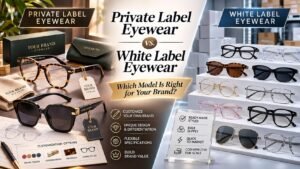
Private label eyewear vs. white label eyewear: the main difference is how much control your brand has over the finished product. White label eyewear typically uses ready-made frames with your branding, while private label eyewear can involve more control over frame colors, lenses, materials, and packaging.
White labeling is usually the faster, lower-investment route. Private labeling offers more opportunities to differentiate your collection, but customization can increase minimum order quantities (MOQs), development costs, and production time.
Neither approach automatically gives you exclusive rights to a frame design.
For eyewear startups, retailers, and established brands, the right choice depends on your budget, launch schedule, and how distinctive your products need to be.
Private Label Eyewear vs. White Label Glasses: Key Differences at a Glance
The terms are sometimes used interchangeably by eyewear manufacturers. For this comparison, white label means branding an existing product with minimal changes, while private label means developing a more personalized product using an established manufacturing design.
Comparison | White Label Glasses | Private Label Eyewear |
Frame design | Existing styles | Existing designs with selected modifications |
Branding | Logo, labels, packaging | Logo and broader product customization |
Frame colors | Usually available colors | Standard or newly developed colors |
Lens options | Existing specifications | More material, tint and coating choices |
MOQ | Often lower for stock products | Depends on production and customization |
Development cost | Usually lower | May include sampling and setup fees |
Lead time | Usually shorter | Longer when new components are required |
Design exclusivity | Generally non-exclusive | Negotiable, not automatic |
Inventory risk | Lower initial commitment possible | Greater commitment for custom production |
Best suited for | Startups and market testing | Growing brands seeking differentiation |
The important question is not simply whether a supplier offers private labeling.
Ask which parts of the eyewear you can actually change, and which parts remain shared with other customers.
An existing acetate frame with your logo may be marketed as private label eyewear by one supplier and white label eyewear by another.
Always compare the technical specifications and commercial terms rather than relying on the label alone.

Customization Options: How Much Control Does Your Eyewear Brand Need?
Eyewear customization has three practical levels. Understanding them helps buyers avoid paying development costs for changes that standard production can already accommodate.
White Label Glasses: Branding Existing Frames
Imagine launching an online sunglasses brand with a limited budget and no established sales history.
You need attractive products with your logo, but you cannot yet predict which shapes or colors customers will purchase.
White label sunglasses provide a practical starting point.
You select existing frames from a manufacturer’s catalog or available inventory and add approved branding elements.
Common options include:
- Logo printing or laser engraving on the temples
- Branded cleaning cloths and pouches
- Custom retail boxes and labels
- Existing frame and lens color combinations
- Barcode and product information labels
The original frame geometry, hinge construction, and materials normally remain unchanged.
This reduces development work and allows you to focus on product photography, pricing, marketing, and customer acquisition.
However, ask whether logo application is performed on existing finished stock or requires a new production run. The answer can substantially change your MOQ and delivery date.
Private Label Eyewear: Customizing an Existing Design
Suppose your first sunglasses collection sells well, but customers consistently request transparent brown frames and darker polarized lenses.
You may not need an entirely new frame design.
Instead, a private label eyewear manufacturer can evaluate whether the existing model supports your preferred material, frame color, lens specification, and branding.
Component | Possible Customization | What Buyers Should Confirm |
Frame material | Acetate, TR90, PC, metal | Whether material changes require redesign |
Frame color | Solid, transparent, patterned | Color approval and production MOQ |
Lenses | PC, TAC polarized, nylon, CR39 | Compatibility, optical performance, testing |
Lens appearance | Grey, brown, gradient, mirror | Tint consistency and transmission |
Branding | Printed, engraved, metal logo | Position, durability, setup cost |
Packaging | Cases, pouches, boxes | Packaging MOQ and artwork approval |
Not every option is compatible with every existing frame.
For example, a frame designed for one lens thickness or curvature may require engineering checks before accepting an alternative lens material.
Private labeling works particularly well when a brand wants recognizable colors and product specifications without investing in a completely new design.
Explore the available options in our eyewear OEM and ODM customization guide.
Fully Custom Eyewear: When You Need a New Design or Mold
A completely original frame requires a different manufacturing process.
If your brand needs a proprietary cat-eye silhouette, a special bridge structure, or a new temple geometry, the manufacturer may need to develop technical drawings, prototypes, and production tooling.
The process depends on the material.
Injection-molded TR90 and PC frames may require new molds. Acetate frames can often be cut from sheets using CNC equipment without a conventional injection mold, although programming, fixtures, finishing, and development still involve costs.
Full customization may include frame dimensions, hinge positions, temple construction, metal components, and lens geometry.
A custom design is not automatically an exclusive design. Ownership and manufacturing rights must be established separately.
For more detail, read our OEM vs. ODM eyewear manufacturing comparison.

MOQ, Cost, and Lead Time: What Should Eyewear Brands Expect?
When comparing manufacturing models, many buyers focus on the price per pair.
That is only one part of the investment.
An order involving 300 custom-colored frames can require more upfront development than a larger order of finished stock frames.
The difference comes from production setup, material preparation, sampling, and whether the factory can use existing components.
Why Minimum Order Quantities Vary
There is no universal MOQ for private label eyewear.
Production Method | Main MOQ Factor | Typical Cost Consideration |
Existing stock with logo | Available inventory and branding process | Logo and packaging fees |
Existing frame, standard colors | Production schedule and material availability | Setup and component purchasing |
Newly developed colors | Material batch and color preparation | Sampling and minimum material usage |
New injection-molded frame | Tooling and production efficiency | Mold development and trial runs |
Custom acetate frame | Material, CNC setup, finishing | Programming, labor and material usage |
For a concrete example, Jion Eyewear’s published private label sunglasses sourcing guide lists 200 pieces per color for certain acetate customization programs and 1,200 pieces total for specified TR90, PC, and metal programs.
These are published program examples, not universal MOQs or guaranteed minimums for every stock or custom order. Your actual requirement depends on the selected model and specifications.
What Costs Should You Include?
Request an itemized quotation rather than a single product price.
The quotation should identify the frame, lenses, logo application, packaging, sampling, tooling where applicable, testing, inspection, and shipping.
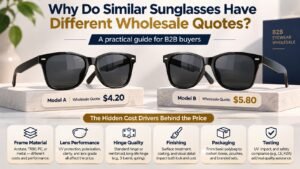
For example, two factories might quote different prices for apparently identical polarized sunglasses.
One quote may include custom packaging and lens testing. The other may cover only the sunglasses in basic protective bags.
Without matching specifications, the cheaper quotation cannot be considered the better offer.
Calculate your expected landed cost before setting your retail price:
Landed cost per pair = Total product, development, packaging, freight, duty, and applicable import costs ÷ Total sellable pairs
This makes comparisons more useful for wholesale buyers and ecommerce brands.
How Long Does Production Take?
White label orders using available inventory can avoid the time required for frame development, although logo application and packaging may still need scheduling.
Private label orders involving new colors or lenses require sample confirmation before bulk production.
Fully custom eyewear adds design reviews, prototype revisions, and potentially mold development.
Instead of accepting a single promised lead time, ask your supplier for three dates: sample completion, approved bulk production completion, and estimated shipment.
The production clock should start from an agreed milestone, such as final specification and sample approval, not merely your first inquiry.

Product Differentiation and Exclusivity: Can Other Brands Sell the Same Frames?
Yes. Other brands may be able to sell the same frame design even when you use private label manufacturing.
The answer depends on the supplier’s rights, your contract, and any applicable intellectual property protection.
The United States Patent and Trademark Office explains that trademarks identify the commercial source of goods. Trademark protection does not, by itself, grant ownership of the product’s physical design.
The World Intellectual Property Organization separately explains that industrial design rights can protect a product’s appearance, subject to applicable legal requirements.
This distinction matters when negotiating eyewear production.
Three Levels of Commercial Exclusivity
Exclusivity Arrangement | What It May Protect | Main Limitation |
Exclusive color combination | Your specified frame/lens combination | Other colors or the base design may remain available |
Market or channel exclusivity | Agreed countries, retailers, or sales channels | Limited by territory, scope and contract duration |
Exclusive design arrangement | Defined design or manufacturing rights | Requires clear ownership and contractual terms |
A supplier might agree not to sell your specific translucent green frame with brown lenses while continuing to sell the same frame in black.
That is different from purchasing exclusive rights to the frame design itself.
Before paying development fees, clarify who owns the drawings, molds, design files, and improvements.
Also establish whether the manufacturer can sell remaining inventory, reuse tooling, or produce the model for other customers.
Paying for a mold does not necessarily settle all these questions.
For a brand building long-term product differentiation, these contractual details may matter more than the logo on the temple.
Which Eyewear Manufacturing Model Is Best for Your Business?
The best manufacturing model depends on what your business needs to achieve next.
Your Business Situation | Recommended Starting Model | Why |
First-time eyewear entrepreneur | White label | Test demand with less development |
Online retailer testing several styles | White label | Compare customer preferences before committing |
Boutique seeking signature colors | Private label | Create a more recognizable collection |
Growing sunglasses brand | Private label | Improve differentiation while using existing designs |
Established designer label | Fully custom OEM | Develop proprietary shapes and construction |
Retail chain introducing house-brand frames | White or private label | Balance consistency, volume and customization |
If You Are Launching Your First Collection
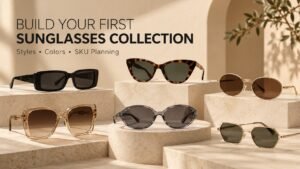
Start with a manageable selection of proven shapes and a limited number of colors.
For example, a retailer could test square, oval, and cat-eye sunglasses before investing in exclusive development.
Do not confuse having more SKUs with having a stronger collection.
Choose products that serve clearly different customers or price points.
Browse our wholesale sunglasses collection to evaluate suitable starting styles.
If You Already Have Repeat Customers
Analyze which frames generate repeat purchases, complaints, and consistent sell-through.
Then customize the strongest performers.
An existing shape with improved lenses, a signature acetate color, and distinctive packaging may deliver enough differentiation without a new mold.
If Design Is Your Competitive Advantage
Consider original development when customers specifically recognize and purchase your brand for its unique frame shapes or fit.
At this stage, proprietary specifications, design ownership, and reliable manufacturing consistency justify greater investment.

How to Work With a Private Label or White Label Eyewear Manufacturer
A successful eyewear project begins with clear purchasing specifications, not a request for the lowest available price.
Step 1: Define Your Product and Market
Identify your intended customers, sales channels, retail price range, and target country.
A budget fashion sunglasses collection and a premium optical frame collection require different materials, lens specifications, and quality expectations.
Step 2: Select the Appropriate Manufacturing Model
Tell the supplier whether you need existing stock with a logo, modified existing designs, or completely new frames.
Share reference images, estimated quantities, and customization requirements.
Step 3: Request Comparable Quotations
Ask for separate prices covering standard products, branded products, and deeper customization where available.
Confirm MOQ per model and per color, rather than accepting only the total order MOQ.
Step 4: Evaluate Physical Samples
Inspect frame balance, hinge movement, lens mounting, color appearance, and logo placement.
Step 5: Approve a Golden Sample
Before mass production, approve a physical reference sample showing the correct frame, lenses, markings, color, and finish.
Keep a signed specification sheet identifying acceptable tolerances.
Step 6: Confirm Quality Control and Shipping
Agree on inspection criteria, packaging quantities, labeling, defect handling, and shipment terms.
Request the relevant test documents and production records before release of the order.
A reliable manufacturer should explain what can be customized, what requires development, and what cannot be guaranteed.

Frequently Asked Questions About Private Label and White Label Eyewear
1. Are private label eyewear and white label eyewear the same?
Not necessarily, although suppliers frequently use the terms interchangeably.
White labeling generally describes applying your brand to an existing product with minimal changes.
Private labeling may allow broader customization of colors, lenses, materials, or packaging.
Neither term alone establishes how the product is designed, who owns the design, or whether competitors can purchase it.
2. Can I start an eyewear brand using white label sunglasses?
Yes. White label sunglasses allow businesses to establish a brand identity without first developing original frames.
You can focus on selecting suitable products, building your website, creating packaging, and reaching customers.
The limitation is product differentiation. If competitors use the same frame, your branding, service, and product positioning become particularly important.
3. Do I own the eyewear design if I use a private label manufacturer?
Not automatically.
Purchasing branded eyewear does not necessarily transfer intellectual property rights.
If you commission a new design, the agreement should identify ownership of the design files, applicable intellectual property, tooling, and manufacturing rights.
Seek qualified legal advice when exclusivity is commercially important.
4. Can I customize the frame colors and lenses of private label eyewear?
Usually, subject to the available manufacturing process.
Frame options may include acetate patterns, transparent colors, solid colors, and metal finishes.
Lens options can include tinted PC, TAC polarized, nylon, and other materials where compatible.
Ask the manufacturer to confirm the physical sample, minimum quantities, optical requirements, and additional costs before approving production.
5. How should color tolerances be confirmed between Pantone references, samples, and mass production?
A Pantone reference is a useful starting point, but it should not be the only acceptance standard.
Transparent acetate, molded plastic, coated metal, and printed packaging can display color differently because of their materials, thicknesses, finishes, and lighting conditions.
Approve a physical color sample on the actual material. Record the sample identification, viewing conditions, and agreed acceptable variation.
There is no single tolerance that automatically works for every eyewear material.
6. Why is the MOQ different for adding a logo to stock frames and developing a new color?
Because the production requirements are different.
Adding a logo to finished inventory may require only a branding setup and suitable available stock.
A newly developed frame color can require material purchasing, pigment preparation, production trials, and a separate manufacturing batch.
For injection-molded products, the factory must also account for setup costs and material usage.
Ask whether the MOQ applies per SKU, per color, per material batch, or across the complete order.
7. Can I switch from white label eyewear to OEM manufacturing later?
Yes. Your manufacturing approach can evolve with your brand.
Many businesses can begin with existing products, introduce customized versions of successful models, and later commission original designs.
Before switching, review your sales data, product specifications, development budget, and supplier agreements.
The safest transition is often gradual: retain proven products while testing an original design through samples and controlled initial production.
Final Recommendation: Choose the Model That Fits Your Brand’s Current Stage
White label eyewear is a sensible choice when speed, flexibility, and market testing are priorities.
Private label eyewear becomes more attractive when you know which designs your customers prefer and want greater control over colors, lenses, and presentation.
Fully custom manufacturing is worth considering when original design and defined ownership rights are central to your business strategy.
You do not need to invest in exclusive tooling simply to launch a credible eyewear brand. Equally, relying indefinitely on shared designs may limit differentiation as your business grows.
At Jion Eyewear, we support brands exploring existing sunglasses, private label customization, and OEM/ODM development.
Whether you are sourcing your first collection or preparing a proprietary product line, we can help evaluate the manufacturing options against your specifications.
Contact Jion Eyewear and share your target market, preferred frame designs, estimated order quantity, and customization requirements.
Request a comparison of three feasible approaches: existing styles with branding, customized existing designs, and fully custom development. We can then identify the applicable MOQ, development costs, sampling requirements, and quotation for each suitable option.