Sunglass lens color changes two distinct things: the exterior aesthetic of the frame and the selective filtering of light reaching the eye. A lens tint shifts contrast and alters how surrounding hues appear, but tint color does not determine UV protection, scratch resistance, or polarization. 100% protection against UVA and UVB rays comes from clear chemical absorbers integrated into the substrate or surface coatings—not darkness or pigment.
For eyewear brands, sourcing the right lens color is an engineering decision balanced against market expectations. A mismatch between color name, substrate material, and Visible Light Transmission (VLT) category will cause customer returns, batch-to-batch discrepancies, and non-compliance with regional optical standards.
What does sunglass lens color actually change?
Lens color primarily changes how the lens looks from the outside and how the scene appears through the lens.
A gray lens, for example, may maintain a relatively neutral appearance when viewed through the lens. A brown lens may give the scene a warmer appearance. A green tint can produce another visual balance.
However, four parameters should not be mixed together:
| Parameter | What it controls | Can lens color alone confirm it? |
|---|---|---|
| Lens color / tint | Visible appearance and color cast | No |
| Lens darkness / VLT | How much visible light passes through | No |
| UV performance | Transmission or blocking of UV radiation | No |
| Polarization | Reduction of selected reflected glare | No |
This distinction matters when developing private-label sunglasses.
For example, Jioneyewear lists TAC polarized, CR39, Nylon and PC among its available lens solutions, while its customization service includes solid, gradient and mirror colors. That means a buyer should not specify an order simply as “brown sunglasses.” The specification should identify the lens material, color, tint level, functional requirements and surface treatment.
One sample can have several different specifications
Consider a buyer requesting a gray sunglass lens.
The buyer could potentially approve:
- Gray PC lens
- Gray TAC polarized lens
- Gray CR39 lens
- Gray lens with a mirror coating
- Gray gradient lens
- Gray lens with different visible light transmission
They may all be described commercially as “gray,” but they are not necessarily the same product.
This is why a physical sample is more useful than a color name alone.
For a Jion project, buyers can request the available physical lens color samples and then confirm the exact combination of lens material + color + tint level + finish + function before bulk production. Jion’s private-label service specifically lists frame and lens color customization, lens functions and physical sample approval as part of the development process.

Gray vs. Brown vs. Green Lenses: A Side-by-Side Comparison
Gray, brown, and green account for more than 85% of standard lifestyle and performance sunglass production runs. Each serves a distinct functional purpose in a brand’s core catalog.
Gray: True Color Neutrality
Gray is an achromatic filter. It dampens overall luminous intensity evenly across the entire visible spectrum (380–780 nm) without favoring or suppressing specific wavelengths.
Gray lenses are commonly selected when a brand wants a relatively neutral-looking sunglass collection.
The main reason is straightforward: gray can create a darker appearance without intentionally pushing the whole scene strongly toward a warm or cool color impression.
That is a general observation, not a guarantee that every wearer will perceive the same result. Individual color perception, lighting conditions, lens density and the exact spectral transmission of the lens all matter.
For buyers, the important question is therefore not simply:
“Can you make gray?”
Instead, confirm:
- Which gray sample?
- What color code?
- What lens material?
- What visible light transmission?
- Is it polarized?
- Is it solid, gradient or mirror?
- What UV performance is required?
Brown lenses
Brown lenses usually create a warmer visual impression than gray lenses.
When comparing a brown sample with a gray sample of similar darkness, a buyer may observe that the brown sample gives the scene a warmer appearance. This is a sample-based observation, not a universal claim about how every person will perceive color.
Brown can also be used as part of fashion-oriented collections because the lens color works naturally with many brown, tortoiseshell, beige and warm-toned frame colors.
For a private-label collection, however, “brown” is still too broad as a production specification.
A buyer should approve the exact sample because:
- Brown can vary from light tea to dark brown.
- The lens material can affect appearance.
- Different tint concentrations change the visual result.
- A mirror coating can change the external appearance.
- Gradient treatment changes the appearance from top to bottom.
Green lenses
Green lenses can range from muted olive and gray-green to stronger fashion-oriented greens.
The final appearance depends on more than the name “green.” The color code, lens material, tint density and coating can all change the result.
This is particularly important when a brand wants to create several green styles across a collection.
Two suppliers may both quote a “green lens” while producing visibly different results.
For this reason, a buyer should keep the approved physical sample as the production reference.
Gray vs Brown vs Green: Buyer Comparison
| Lens color | Appearance | Observable difference | Parameters to confirm | |
|---|---|---|---|---|
| Gray | Neutral / smoke appearance | Generally less warm-looking than brown | Color code, VLT, material, polarization, finish | |
| Brown | Warm appearance | May give the scene a warmer visual impression | Color code, VLT, material, polarization, finish | |
| Green | Green / olive / gray-green appearance | Appearance can vary considerably by formulation | Color code, VLT, material, coating | |
| Mirror gray/brown/green | Reflective exterior | External color may differ from view-through color | Base tint, mirror color, VLT, material | |
| Gradient color | Darker/lighter across lens | Visual density changes by position | Gradient range, direction, VLT |
The key point is simple: a lens color name is not a complete lens specification.

What About Yellow, Rose, and Blue Tints?
High-contrast and fashion-forward tints serve dedicated niches in athletic performance and editorial design collections.
Yellow lenses
Yellow lenses have a distinctly warm appearance and are frequently used in fashion and lifestyle eyewear.
Some lens designs use yellow or light orange tints for specific visual applications. However, a yellow tint should not automatically be marketed as a night-driving safety solution.
Whether a lens is suitable for driving depends on its complete optical specification, visible transmission and applicable market requirements.
Rose lenses
Rose or pink lenses can create a softer fashion appearance and are useful for collections where the lens itself is part of the product’s visual identity.
The final result depends heavily on tint density and the base material.
Blue lenses
Blue lenses are frequently used for fashion collections and colorful sunglasses.
But buyers need to distinguish between:
Blue base tint
and
blue mirror coating.
A blue mirror coating is applied to the outside surface. It does not necessarily mean that the wearer sees the world through a blue base lens.
This distinction is important when approving samples.
A pair of sunglasses can have:
Gray base lens + blue mirror
rather than:
Blue base lens
The outside may look strongly blue while the view through the lens remains closer to gray.

Does a Darker Lens Provide More UV Protection?
No. Lens darkness is completely independent of UV protection.
Dark lenses without verified UV400 absorption are hazardous. When a dark lens covers the eye, it reduces ambient visible light, prompting the pupil to dilate naturally. If the lens lacks UV-absorbing compounds, the dilated pupil allows more harmful UVA and UVB radiation to penetrate deep into the crystalline lens and retina than if no sunglasses were worn at all.
According to the World Health Organization (WHO) and the U.S. Food and Drug Administration (FDA), safe sunglasses must block 99% to 100% of both UVA and UVB radiation, regardless of whether the lens is clear, pale yellow, or dark gray. When auditing production runs, brands should look at spectrophotometer test reports verifying compliance with:
ANSI Z80.3 (United States)
ISO 12312-1 (European Union & International)
AS/NZS 1067.1 (Australia / New Zealand)
How Do Solid, Gradient, and Mirror Options Relate to Color?
A lens spec consists of two layers: the base tint application and the optical surface treatments.
1. Solid Tints
The lens possesses uniform VLT and color density from top to bottom. It is achieved through:
Dip-dyeing: Submerging organic substrates (CR-39, Nylon) into heated dye solutions until the target saturation is reached.
In-mass coloration: Blending pigments directly into raw polycarbonate or polyamide pellets before injection molding.
Typical specification:
Gray / PC / solid / specified VLT / UV requirement
2. Gradient Tints
The lens transitions smoothly from a darker shade at the top (e.g., 80% absorption for overhead sun reduction) to a lighter shade at the bottom (e.g., 20–30% absorption for reading instrument panels or looking at a phone screen).
The buyer should confirm:
- Dark-to-light direction
- Approximate gradient area
- Base color
- Color transition
- Overall transmission
- Whether both lenses match
Gradient does not mean the lens has to use a single color only. Different color treatments can be developed depending on the design.
3. Mirror & Flash Coatings
A microscopic reflective stack applied via Vacuum Physical Vapor Deposition (PVD).
Not Mutually Exclusive: A lens can feature a gradient brown base combined with a subtle gold flash mirror, or a solid neutral gray base with a deep cobalt blue mirror. The base tint determines how the wearer views the world; the mirror coating reflects extra glare and dictates the exterior aesthetic.
Understanding Lens Categories: CAT 0 to CAT 4
International sunglass safety standards (ISO 12312-1 / ANSI Z80.3) classify sunglasses into five categories based on Visible Light Transmission (VLT).
| Category | Typical VLT Range | Visual Description | Intended Real-World Use | Driving Suitability |
| CAT 0 | 80% – 100% | Clear or very pale tint | Indoor eye protection, safety glasses, night wear, fashion accessories | Safe day & night |
| CAT 1 | 43% – 80% | Light tint (yellow, pale rose, soft blue) | Weak sunlight, overcast weather, indoor lifestyle styling | Safe during daytime; unsafe at night |
| CAT 2 | 18% – 43% | Medium tint (general fashion sunglasses) | Average daylight, partial cloud cover, urban leisure wear | Safe during daytime only |
| CAT 3 | 8% – 18% | Dark tint (industry benchmark for general sunwear) | Strong sunlight, seaside, open driving, bright summer conditions | Safe during daytime only |
| CAT 4 | 3% – 8% | Extremely dark tint (high-glacier lenses) | High-altitude mountaineering, open snowfields, desert expeditions | Strictly prohibited for driving |
Most commercial sunglass collections target CAT 3 for all-around protective sunglasses or CAT 2 for lighter cosmetic and vintage-inspired designs.

What Should an Eyewear Brand Specify When Ordering Lens Colors?
Avoid vague descriptions like “dark tortoise with vintage green glass.” To avoid manufacturing bottlenecks and sample revision cycles, include these six parameters in your Tech Pack:
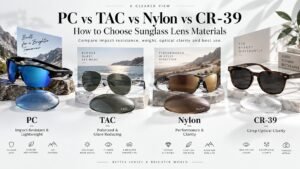
Lens Substrate Material: Specify CR-39, Polyamide (Nylon), Polycarbonate (PC), TAC, or Mineral Glass. Note that color absorption and optical clarity (Abbe value) vary by material.
Color Target / Code: Provide a verified physical swatch, an established master production lens sample, or a recognized standard (e.g., Pantone reference for gradient and solid hues).
Surface & Finish Requirements: Define whether the lens is Solid, Gradient, Revo Mirror, or Flash Mirror. Explicitly mandate back-surface AR (Anti-Reflective) coating to eliminate bounce-back glare.
Performance requirements
Confirm separately:
- UV performance
- Polarization
- Visible light transmission / filter category
- Any market-specific testing requirements
- Other required lens treatments
Polarization and UV protection should not be treated as the same specification.
FAQ
Is gray or brown better for everyday sunglasses?
Neither is automatically better. Gray is commonly selected for a more neutral appearance, while brown can produce a warmer visual impression. The better option depends on the target product and approved sample.
Are green lenses polarized?
Not necessarily. Green describes the lens color, while polarization describes a separate lens function. A green lens can be polarized or non-polarized.
Are mirrored blue lenses blue when you look through them?
Not necessarily. A blue mirror coating is on the outer surface. The base lens underneath can be gray, brown, green or another color.
Can the same lens color be made in different materials?
Yes, depending on the manufacturing specification. The same general color can be developed in materials such as PC, TAC, CR39 or Nylon, but the final appearance should be checked through physical samples.
How can a brand approve a color before bulk production?
Request a physical sample, confirm the color reference, lens material, tint level, surface treatment and performance requirements. Then approve the final sample as the production reference.
Conclusion
Choosing a sunglass lens color is not simply a matter of selecting gray, brown, green or blue from a catalog.
For a B2B eyewear project, the color should be treated as one part of a larger lens specification. Color, visible light transmission, UV performance, polarization, material and surface treatment should be confirmed separately.
This prevents a common sourcing problem: the supplier delivers a lens that is technically described as the requested color but looks different from the buyer’s approved sample.
For private-label sunglasses, physical sample approval is therefore one of the simplest ways to control color consistency before bulk production.
Request Available Lens Color Samples
Send your target lens color, preferred material, required lens function and approximate order quantity. Jioneyewear can help you confirm suitable lens samples before bulk production.