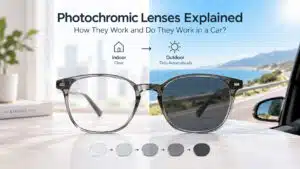
Photochromic lenses change their light transmission when exposed to light, becoming darker outdoors and lighter indoors. However, standard photochromic lenses may not darken strongly behind a car windshield because the windshield blocks much of the UV radiation that activates many photochromic technologies. Some newer lens designs are engineered to activate behind the windshield, but buyers should confirm the actual in-car performance rather than assuming every photochromic lens works in a vehicle.
For eyewear brands, the important specifications are not simply “photochromic” or “automatic tint.” You should confirm the lens activation method, faded and darkened VLT, reaction time, temperature performance, UV protection, and performance behind a windshield before approving a production sample.
What Are Photochromic Lenses?
Manufacturers embed or coat lenses with specialized organic photochromic dyes—predominantly naphthopyrans, spirooxazines, and indenonaphthopyrans—into resin substrates such as CR-39 (allyl diglycol carbonate) and polycarbonate (PC).
Photochromic lenses are light-responsive lenses that change their visible light transmission according to the surrounding light conditions.
When exposed to suitable UV radiation or sunlight, the lens becomes darker. When the activating light is removed, the lens gradually returns toward its lighter state.
This makes photochromic lenses different from conventional tinted sunglasses.
A conventional tinted lens has a relatively fixed visible light transmission. A photochromic lens has at least two practical states:
- Faded state: lighter for indoor or lower-light conditions
- Activated state: darker for outdoor sunlight
The actual performance depends on the lens technology, material, temperature, light spectrum, and activation conditions.
How Do Photochromic Lenses Work?
The basic principle is a reversible light-sensitive reaction inside or on the lens material.
When the lens receives the appropriate activating radiation, photochromic molecules change their structure and absorb more visible light. The lens therefore appears darker.
When the activating radiation is reduced, the molecules gradually return toward their original state. The lens becomes lighter again.
The process can be summarized as:
Light exposure → photochromic activation → increased light absorption → darker lens
and:
Reduced activation → photochromic relaxation → lower light absorption → lighter lens
The important point is that photochromic lenses do not simply “detect brightness” in the same way an electronic sensor would. The lens response depends on the radiation reaching the photochromic material.
That distinction becomes important when the wearer is inside a car.

Do Photochromic Lenses Work in a Car?
Standard UV-activated photochromic lenses may show limited darkening inside a car.
The reason is the windshield.
Many vehicle windshields are designed to block substantial amounts of ultraviolet radiation. If the photochromic lens depends primarily on UV exposure for activation, less activating radiation reaches the lens behind the windshield.
Therefore, a lens that becomes strongly tinted outdoors may remain relatively light inside a vehicle.
However, this does not mean that every photochromic lens stays clear in a car.
Some newer photochromic products are specifically designed to respond to a broader range of light conditions and can provide additional activation behind the windshield. For example, Transitions XTRActive products are marketed for activation and additional darkness in the car.[1]
For a private-label buyer, the correct question is therefore not:
“Are photochromic lenses suitable for driving?”
A better question is:
“What is the measured VLT of this lens behind a windshield under the target test conditions?”
That result is much more useful for product selection.

What Does VLT Mean for Photochromic Lenses?
VLT means Visible Light Transmission.
It describes the percentage of visible light transmitted through the lens.
For example:
- 80% VLT means approximately 80% of visible light passes through.
- 20% VLT means approximately 20% passes through.
- 10% VLT means approximately 10% passes through.
A lower VLT means a darker lens.
This is one of the most important specifications for a photochromic eyewear buyer because the lens has changing transmission.
Common Sunglass VLT Categories
ISO 12312-1 uses filter categories based on luminous transmittance for general-use sunglasses. The commonly referenced ranges are approximately:
| Filter Category | VLT Range | General appearance |
|---|---|---|
| Category 0 | 80–100% | Very light |
| Category 1 | 43–80% | Light tint |
| Category 2 | 18–43% | Medium tint |
| Category 3 | 8–18% | Dark tint |
| Category 4 | 3–8% | Very dark |
These categories are useful when comparing photochromic performance, but a photochromic lens can move between categories as it changes state.
For example, a lens may have a high VLT when faded and reach a much lower VLT outdoors.
Do not treat “Category 3 photochromic” as sufficient product information.
Why Does Temperature Affect Photochromic Lenses?
Temperature can affect both the depth of activation and the speed at which a photochromic lens changes state.
In general, temperature is an important variable when evaluating photochromic performance.
A lens tested in a controlled laboratory environment may behave differently in a cold winter environment or inside a hot vehicle.
This matters for brands selling eyewear across different regions.
Temperature and Reaction Speed
Photochromic performance involves two different questions:
- How dark can the lens become?
- How quickly does it become darker or lighter?
These should not be confused.
A lens can reach a suitable dark state but still take longer to reach it.
Similarly, a lens can fade relatively quickly without reaching the desired clear-state VLT immediately.
For product development, ask for both:
- Darkening time
- Fading time
and specify the test conditions.
A useful supplier test request could include:
23°C / controlled light source / defined starting VLT / defined ending VLT
For more demanding markets, also request results at lower and higher temperatures.
How Fast Do Photochromic Lenses Change?
There is no single reaction time that applies to all photochromic lenses.
Performance depends on:
- Lens technology
- Lens material
- Temperature
- Light intensity
- UV exposure
- Starting lens state
- Target dark state
- Test method
This is why statements such as “changes instantly” are not useful for B2B product evaluation.
Instead, ask the supplier to define the measurement.
For example:
Darkening: 80% VLT → 15% VLT under a specified light source
Fading: 15% VLT → 80% VLT under a specified indoor condition
Then record the time required for each transition.
This gives a buyer a much more useful comparison between two lens suppliers.
Indoor vs. Outdoor Performance
A good photochromic lens should provide a meaningful difference between its faded and activated states.
However, “clear indoors” can mean different things.
A lens with 80% VLT and a lens with 60% VLT may both be described commercially as light indoors, but they do not transmit the same amount of visible light.
For private-label eyewear, specify the desired VLT rather than relying only on appearance.

Are Photochromic Lenses Suitable for Driving?
They can be, but the answer depends on the lens design and its final VLT.
Its transmittance requirements are therefore relevant when developing sunglasses intended for these applications.
However, buyers should separate two questions:
Does the lens change behind the windshield?
and:
Is the resulting VLT appropriate for the intended driving conditions and market?
A lens that activates strongly behind a windshield may be useful for daytime driving. But its actual light transmission still needs to be evaluated.
Do not market a photochromic product as suitable for all driving conditions without verifying its measured performance.
Photochromic Lenses vs. Fixed-Tint Sunglasses
| Factor | Photochromic lenses | Fixed-tint sunglasses |
|---|---|---|
| Indoor use | Usually more convenient | Usually requires removing sunglasses |
| Outdoor use | Automatically darkens | Fixed darkness |
| Light adaptability | High | Low |
| In-car performance | Technology dependent | Predictable |
| VLT | Changes within a range | Relatively fixed |
| Product positioning | Everyday adaptive eyewear | Traditional sunglasses |
| Buyer testing | More variables | Simpler |
| Main sourcing concern | Activation + VLT range | VLT + optical performance |
For a brand, photochromic lenses can create a different product proposition from conventional sunglasses.
But they also require more careful product validation.
Which Eyewear Products Are Best Suited to Photochromic Lenses?
Photochromic technology can be considered for several B2B product categories.
Everyday Eyewear
This is one of the most straightforward applications.
The wearer can use the same pair indoors and outdoors without changing between clear and tinted eyewear.
This is suitable for brands positioning around convenience and everyday use.
Sports Eyewear
Photochromic lenses can be useful for outdoor activities where lighting conditions change during use.
However, the lens should be evaluated under the specific conditions of the sport.
For example, cycling eyewear may need different optical, coverage, impact, and ventilation requirements from casual sunglasses.
Outdoor Lifestyle Eyewear
Brands targeting walking, commuting, travel, and other outdoor activities may use photochromic lenses as a functional product feature.
The key commercial advantage is not simply “the lens changes color.”
It is the ability to use one product across changing light conditions.
Driving-Oriented Eyewear
This category requires more careful development.
If driving is part of the product positioning, the buyer should specifically request in-car activation testing.
A standard outdoor photochromic test does not tell you enough about windshield performance.
FAQ: Questions Buyers Commonly Ask
1. Do photochromic lenses get dark inside a car?
Not necessarily. Many conventional photochromic lenses rely strongly on UV activation, while a windshield can reduce the UV reaching the lens. Some newer technologies are designed to provide more activation behind the windshield. Always request actual in-car test results.
2. What VLT should I choose for photochromic sunglasses?
It depends on the intended market and application. For general sunglasses, ask for the exact faded and activated VLT rather than choosing by lens color alone.
3. Do photochromic lenses work in cold weather?
Yes, but temperature can affect activation behavior and reaction speed. Buyers targeting cold climates should request performance data at lower temperatures rather than relying only on room-temperature samples.
4. How long do photochromic lenses take to darken and clear?
There is no universal time. Darkening and fading can have different speeds, and temperature and light conditions affect performance. Ask the supplier for test results under defined conditions.
5. Can I use photochromic lenses for a private-label eyewear collection?
Yes. Photochromic lenses can be incorporated into private-label sunglasses or optical products depending on the frame and lens specifications. Before bulk production, confirm the lens material, VLT range, activation performance, UV protection, target-market requirements, and packaging specifications.
Conclusion
Photochromic lenses are useful when a product needs to adapt to changing light conditions, but the technology should be evaluated through measurable performance rather than appearance alone.
For eyewear buyers, the most important specifications are faded VLT, activated VLT, darkening time, fading time, temperature performance, UV protection, and windshield performance.
For an OEM or ODM project, define these requirements before sample approval. Jioneyewear supports custom eyewear development using lens options including PC, CR39, Nylon, and other lens configurations, with private-label customization available according to project requirements.
Send us your target market, frame style, lens color, required photochromic performance, and logo requirements. We can review the specification and help you define the appropriate sample requirements.