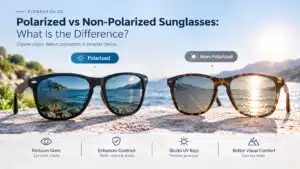
Polarized and non-polarized sunglasses both reduce brightness, but they do not control reflected glare in the same way. Polarized lenses use a filter to reduce strong horizontal reflections from roads, water, snow, and other surfaces. Non-polarized lenses mainly reduce overall light through tint. Neither type is automatically better for UV protection: UV protection depends on the lens specification. For buyers, the right choice depends on the target market, use case, lens requirements, and product positioning.
Polarized vs Non-Polarized Sunglasses: Quick Comparison
| Feature | Polarized Sunglasses | Non-Polarized Sunglasses |
|---|---|---|
| Main function | Reduces reflected glare | Reduces overall brightness |
| Glare from roads and water | Strong reduction | Limited reduction |
| UV protection | Can provide 99–100% UV protection when specified | Can provide 99–100% UV protection when specified |
| Visual comfort outdoors | Usually better in strong reflected glare | Depends mainly on tint and lens design |
| Driving | Useful for daytime glare | Suitable when glare reduction is not the main requirement |
| Water activities | Very suitable | Basic sun protection |
| Fashion use | Available in many colors and styles | Very broad styling options |
| Screen compatibility | May darken some LCD displays at certain angles | Generally no polarization effect |
| Sourcing consideration | Requires polarized lens specification and testing | Simpler lens function selection |
The important point for buyers is simple: polarization and UV protection are two different lens functions. A polarized lens is not automatically a UV-protective lens, and a non-polarized lens is not automatically less protective.
What Is the Difference Between Polarized and Non-Polarized Lenses?
The main difference is how the lens handles light.
A non-polarized sunglass lens reduces the amount of visible light reaching the eye. The lens may use a gray, brown, green, blue, or other tint. The tint makes the environment appear darker and more comfortable in bright conditions.
A polarized lens adds a polarization filter. This filter selectively reduces light traveling in a particular polarization direction, especially the strong reflected light commonly produced by horizontal surfaces.
For buyers, this creates an important product distinction.
If you are developing a fashion sunglasses collection for general outdoor use, a non-polarized lens may be sufficient. If your product targets drivers, fishermen, boaters, cyclists, or outdoor users exposed to strong surface reflections, polarized lenses can provide a more specific benefit.
The custom lens options offered by Jion Eyewear for sunglasses and outdoor eyewear include TAC polarized lenses.
How to Tell Polarized and Non-Polarized Lenses Under a Computer Screen
A computer or LCD screen can provide a quick visual test, although it is not a formal lens test.
Put on the sunglasses and look at an LCD screen such as a laptop, tablet, or certain smartphone displays.
Then slowly rotate the sunglasses approximately 90 degrees.
With many LCD screens, polarized lenses will become noticeably darker at a particular angle. The screen may partially disappear or become much harder to see.
A non-polarized lens normally will not produce the same strong darkening effect.
Why does this happen?
Many LCD displays use their own polarization layers. When a polarized sunglass lens is placed over the display, the two polarization systems interact.
As the sunglass lens rotates, the amount of light passing through the two filters changes.
This is why a polarized lens can make some digital displays look dark at certain angles.
However, this test should be treated as a quick demonstration rather than a laboratory verification. Different screens use different display technologies, so the effect can vary.
A practical buyer test
For a product sample review, buyers can:
- Look at an LCD screen through the sunglasses.
- Rotate the sunglasses slowly.
- Check whether the screen becomes significantly darker.
- Compare the result with a confirmed non-polarized lens.
- Use proper lens testing if the specification needs to be verified for production.
This is especially useful when checking whether a supplier has delivered the requested polarized lens rather than a standard tinted lens.

How to Test Polarized and Non-Polarized Lenses With a Polarization Test Card
A polarization test card is another simple demonstration tool.
A typical polarized test card contains an image that becomes visible only when viewed through a polarized filter.
Place the sunglasses over the test area.
If the sunglasses are polarized, the hidden image or pattern should become visible.
If the sunglasses are non-polarized, the hidden pattern normally remains invisible.
This test is useful during sample checking because it gives buyers a quick visual indication of whether polarization is present.
However, the test card does not replace production testing. For commercial eyewear, buyers should confirm the actual lens specification, material, polarization performance, UV performance, and applicable testing requirements before approving bulk production.

How Do Polarized Sunglasses Work?
Polarized sunglasses work by using a polarization filter inside the lens structure.
Natural sunlight contains light traveling in many directions. When sunlight hits a flat surface such as water, a wet road, snow, or another reflective surface, a large portion of the reflected light becomes horizontally polarized.
That reflected light enters the eyes as intense glare.
A polarized filter is designed to reduce much of this horizontally oriented reflected light.
The result is different from simply making the lens darker.
A darker non-polarized lens reduces the overall amount of light.
A polarized lens specifically targets a major source of reflected glare.
This is why two sunglasses with a similar visible tint can provide noticeably different visual comfort outdoors.
What Does a Polarizing Filter Do?
A polarizing filter acts like a directional light filter.
It allows certain orientations of light to pass while reducing others.
For sunglasses, the practical benefit is the reduction of reflected glare.
Consider a sunny road after rain.
Without polarization, sunlight reflects from the wet surface and creates bright patches across the driver’s field of view.
A tinted lens makes the entire scene darker.
A polarized lens can reduce much of the strong reflected component while maintaining a more usable view of the surrounding scene.
The same principle applies to water.
When sunlight reflects from a lake, river, or ocean, the reflected light can become very bright. Polarization can reduce this surface glare and make it easier to see through the reflected brightness.
This is one reason polarized lenses are commonly positioned for fishing, boating, driving, cycling, and other outdoor applications.
Why Do Roads and Water Produce So Much Glare?
Flat surfaces are particularly effective at producing reflected light.
Road surfaces can reflect sunlight directly toward a driver’s eyes. The problem becomes more noticeable when the surface is wet.
Water can create an even stronger visual effect because sunlight reflects from a broad, relatively flat surface.
Snow can also produce substantial glare because its bright surface reflects sunlight across a large area.
The result is not simply a brighter environment. It is concentrated reflected light that can make details harder to see and create visual discomfort.
The American Optometric Association specifically notes that polarized lenses can help reduce glare from horizontal surfaces during driving, cycling, and water activities.
For eyewear buyers, this explains why polarized sunglasses are not just a cosmetic upgrade. They are particularly relevant when the intended use involves strong reflected light.
What Do Non-Polarized Sunglasses Do?
Non-polarized sunglasses still have an important role in the market.
Their primary function is to reduce the amount of visible light entering the eyes through the lens tint.
For example, a gray non-polarized lens reduces brightness while generally maintaining a relatively neutral appearance.
A brown lens can create a warmer visual appearance.
Other colors can support different fashion directions or product positioning.
Non-polarized sunglasses can therefore be suitable for:
- Fashion eyewear
- Everyday outdoor use
- Retail collections where lens color is the main design element
- Promotional eyewear
- Markets where polarization is not a key selling point
- Products where certain display compatibility considerations matter
The absence of polarization does not mean the lens is low-grade.
A properly specified non-polarized lens can still provide strong UV protection, suitable visible light transmission, optical quality, and the appearance required by the product design.
Polarized vs Non-Polarized: UV Protection
This is one of the most important points for eyewear buyers.
Polarization and UV protection are separate specifications.
A polarized lens can have UV protection.
A non-polarized lens can also have UV protection.
The polarization filter itself should not be treated as proof of UV protection.
The National Eye Institute recommends sunglasses that block 99% to 100% of UVA and UVB radiation, or products marked with an appropriate UV400 specification.
Therefore, when developing a sunglasses product, buyers should specify UV performance separately from polarization.
Can polarized lenses protect eyes from UV?
Yes, if the lens is manufactured and specified to provide the required UV protection.
Polarization alone should not be used as the UV specification.
For a private label project, buyers should confirm UV performance as a separate requirement during sampling and production.
Can non-polarized sunglasses provide 100% UV protection?
Yes.
A non-polarized lens can be designed to block 99–100% of UVA and UVB radiation.
The National Eye Institute recommends looking specifically for this level of UV protection rather than judging protection based on price, darkness, or polarization. [3]
This distinction matters because a very dark lens without adequate UV protection is not the same product as a properly specified UV-protective sunglass lens.
The American Optometric Association also recommends sunglasses that block 100% of UVA and UVB radiation. [4]
Polarized vs Non-Polarized Sunglasses for Driving
For daytime driving, polarized sunglasses can be useful because they reduce reflected glare from roads and other horizontal surfaces.
However, polarized sunglasses are not automatically the right solution for every driving environment.
Buyers should consider lens color, visible light transmission, optical quality, and traffic signal recognition.
The goal is not simply to make the lens as dark as possible.
For commercial products, a neutral gray tint is often considered when accurate color recognition is important.
Another consideration is digital displays.
Some LCD screens can appear darker through polarized lenses at certain viewing angles. This may matter for vehicles with certain dashboard or navigation displays.
Polarized vs Non-Polarized Fashion Sunglasses
For fashion sunglasses, the decision is different.
The primary buying factor may be frame shape, lens color, logo placement, material, and overall brand appearance rather than glare reduction.
Non-polarized lenses can offer more flexibility for fashion-oriented collections.
Polarized lenses can still be used in fashion products, especially when the brand wants to combine a lifestyle appearance with outdoor functionality.
For B2B buyers, this creates an opportunity to separate collections by use case rather than choosing one lens type for every model.
Which Applications Are Best for Polarized Lenses?
| Application | Polarized Lens | Non-Polarized Lens | Buyer Recommendation |
|---|---|---|---|
| Driving | Excellent for daytime reflected glare | Suitable for basic sun protection | Polarized is useful |
| Fishing | Excellent | Basic | Polarized preferred |
| Boating | Excellent | Basic | Polarized preferred |
| Cycling | Useful | Suitable | Depends on road glare |
| Beach | Useful | Suitable | Polarized adds glare reduction |
| Snow sports | Useful for reflected glare | Suitable | Consider polarization and lens category together |
| Everyday outdoor use | Useful | Suitable | Both can work |
| Fashion sunglasses | Optional | Very suitable | Choose by product positioning |
| Indoor-to-outdoor fashion | Depends on design | Suitable | Consider other lens functions |
| Digital display-heavy use | May affect some LCD displays | Generally easier | Test samples first |
The table should not be interpreted as a universal rule.
The best lens depends on the product’s intended market, price level, frame design, and customer expectations.
Polarized vs Non-Polarized Sunglasses: Pros and Cons
| Type | Advantages | Limitations |
|---|---|---|
| Polarized | Reduces reflected glare; useful for roads and water; improves outdoor visual comfort | Can affect visibility of some LCD displays; usually requires a more specific lens specification |
| Non-polarized | Simple light reduction; broad fashion applications; many tint options | Does not selectively reduce reflected glare like a polarized filter |
For a B2B buyer, the decision should be based on product positioning rather than assuming polarized is always better.
If your customers spend time outdoors around roads, water, or snow, polarization can be a strong product feature.
If your collection is mainly fashion-driven, non-polarized lenses may provide more design flexibility and may be sufficient for the intended use.
What Should Buyers Confirm Before Ordering Polarized Sunglasses?
Polarization should be treated as one part of the lens specification.
When requesting samples or production quotations, confirm:
1. Lens material
Common options include TAC, PC, nylon, and CR-39, depending on the product design and application.
Jion Eyewear’s OEM/ODM range includes TAC polarized lenses as well as PC, nylon, and CR-39 lens options.
2. UV specification
Do not simply write “polarized.”
Specify the required UV performance separately.
For example:
TAC polarized + UV400
3. Lens color
Confirm whether you need:
4. Logo method
If branding is required, confirm whether the logo will be applied to the temple, lens, packaging, or other components.
FAQ: Polarized vs Non-Polarized Sunglasses
1. Are polarized sunglasses better than non-polarized sunglasses?
Not in every situation. Polarized lenses are better at reducing reflected glare, while non-polarized lenses can be sufficient for general sun protection and fashion use.
2. Are polarized sunglasses automatically UV400?
No. Polarization and UV protection are separate lens functions. Confirm the UV specification separately.
3. Can I use polarized sunglasses for driving?
Yes, polarized sunglasses can be useful for daytime driving because they reduce reflected glare from roads. Buyers should also check tint, visible light transmission, color recognition, and display compatibility.
4. How can I tell if sunglasses are polarized?
A quick method is to rotate the sunglasses in front of an LCD screen. A polarization test card can also reveal whether the lens has a polarization filter.
5. Should I choose polarized lenses for my private label sunglasses?
Choose polarized lenses when your target customers need glare reduction from roads, water, snow, or other reflective surfaces. For fashion-only products, non-polarized lenses may be sufficient.
Final Conclusion: Which Sunglasses Should Buyers Choose?
The difference between polarized and non-polarized sunglasses is not simply about which lens is “better.”
Polarized sunglasses reduce reflected glare. Non-polarized sunglasses mainly reduce overall brightness through tint.
For driving, fishing, boating, cycling, and other outdoor applications, polarization can provide a meaningful functional benefit.
For fashion collections and general outdoor products, non-polarized lenses remain a practical option.
The most important sourcing point is to separate polarization, UV protection, tint, lens material, and visible light transmission in your product specification.
If you are developing a private label sunglasses collection, send us your target market, preferred lens function, frame style, logo requirements, and estimated quantity. We can help evaluate suitable lens and frame options for your project.