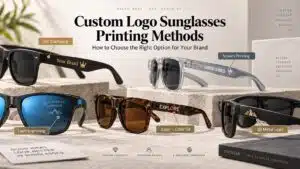
Choosing the right custom logo sunglasses method starts with the frame—not the logo file. Silk printing works well for economical color branding, laser engraving creates a clean permanent mark, hot stamping adds metallic detail, color-filled engraving improves contrast, and 3D metal logos suit premium collections. The best method depends on frame material, logo position, durability, quantity and target retail price.
For buyers, that distinction matters.
A gold logo that looks excellent on a computer screen may be difficult to reproduce on a narrow TR90 temple. A beautifully engraved logo can disappear on tortoiseshell acetate. A large metal badge may make a lightweight fashion frame feel visually unbalanced.
Logo development should therefore happen together with the frame specification—not after the sunglasses are already finalized.
5 Common Logo Methods Used on Sunglasses

For most private-label sunglasses projects, buyers will encounter five main frame-logo options: hot stamping, silk or pad printing, laser engraving, laser engraving with color filling, and 3D metal logos.
Each creates a different visual impression and requires a different production process.
1. Hot Stamping

Hot stamping transfers foil onto the frame surface using controlled heat and pressure. Gold, silver and other metallic finishes are the most recognizable applications.
KURZ, a specialist in surface-decoration technology, describes hot stamping for plastic components as a process combining heat and pressure to transfer decorative finishes onto plastic surfaces.
For eyewear, it is particularly useful when the buyer wants a refined metallic logo without adding a separate physical component.
Best suited to: acetate temples, selected coated plastic surfaces and premium fashion collections.
Commercial advantage: a small metallic logo can immediately raise the perceived value of an otherwise minimalist frame.
Imagine two identical black acetate sunglasses. One carries a basic white printed brand name; the other uses a small gold-foil logo on the inner temple. The manufacturing difference is minor compared with changing the entire frame construction, but the second version can communicate a noticeably more premium brand position.
The limitation is geometry. Very narrow temples, strongly curved surfaces or extremely fine artwork may not provide a stable stamping area. Always approve a physical sample rather than judging foil appearance only from a rendering.
2. Silk-Screen or Pad Printing

Printing is one of the most flexible options for private-label sunglasses because it allows colored logos, text, model numbers and other information to be applied directly to the frame.
In eyewear factories, the exact technique may be silk-screen printing or pad printing depending on the shape and curvature of the surface.
It is commonly used for:
- brand names on inner or outer temples
- model numbers
- country-of-origin information
- color codes
- short technical text
Printing is especially useful when the logo must retain a specific brand color.
However, ink adhesion is not simply a matter of applying the same ink to every plastic. Nazdar’s technical guidance emphasizes matching ink to substrate and recommends pretesting the actual substrate because adhesion varies with material formulation, curing conditions and surface preparation.
That principle is directly relevant to sunglasses manufacturing.
A logo that performs well on PC should not automatically be assumed to perform identically on TR90, acetate or a painted metal surface.
For bulk orders, approve the actual production combination: frame material + surface treatment + ink + curing method.
3. Laser Engraving

Laser engraving removes, modifies or marks the surface instead of depositing ink or foil.
The result is typically understated, precise and durable.
This makes laser logos useful for buyers who want branding that feels integrated into the product rather than printed on top of it.
Laser equipment manufacturers document that many metals and plastics—including polycarbonate—can be laser marked, although the exact visual result depends on the material and laser process used.
Best suited to: metal temples, selected plastics, acetate components and internal branding areas after material testing.
Laser engraving is particularly effective when:
the brand identity is minimalist;
the logo is monochrome;
long-term readability matters more than bright color;
or the logo should not look like an inexpensive surface print.
Its weakness is contrast. A laser mark can be physically precise but visually weak if the substrate does not create enough tonal difference.
That is where color filling becomes useful.
4. Laser Engraving With Color Filling
Laser color filling is essentially a two-stage branding process.
First, the logo is engraved into the frame. Pigment or paint is then applied into the recessed area so the mark becomes more visible.
This creates more depth than normal printing while allowing stronger color contrast than untreated engraving.
For example, imagine a thick transparent-grey acetate temple.
A simple laser logo may be difficult to see. Engraving the same artwork and filling it with white, black or metallic paint creates a much more intentional visual detail.
This method works especially well for brands that want a logo to feel permanent but still need a visible brand color.
Production control is important, however. Extremely narrow engraved lines leave very little space to retain paint. Poorly designed artwork may produce incomplete filling, uneven edges or paint loss during finishing and daily wear.
The original vector artwork may therefore need manufacturing adjustments even if the digital design looks perfect.
5. 3D Metal Logo

A 3D metal logo is a separate metal component attached, inserted or mounted onto the temple.
Of the five methods, this usually creates the strongest physical brand presence.
It is particularly suitable for:
premium acetate sunglasses;
thicker temples;
fashion collections where hardware is part of the design language;
and brands trying to create a recognizable signature element.
A metal logo can use finishes such as gold, silver, gunmetal or other plated effects depending on the project.
But it should not automatically be considered the “best” logo.
Metal decoration adds another component, additional assembly work and usually greater development complexity. The temple must also provide enough thickness and structural area for the component.
For an entry-price promotional frame, a metal emblem may add cost without increasing sell-through.
For a premium acetate collection retailing at several times that price, the same detail may support the intended positioning.
The correct decision is therefore commercial as much as technical.
Lens Logos and Lens Etching Are Different From Temple Logos
Lens branding serves a different purpose.
A temple logo identifies the product and can become a visible fashion detail when the sunglasses are worn. A lens logo sits directly inside the customer’s field of view and therefore needs much more restraint.
Typical lens branding includes small corner logos, subtle laser marks or printed marks located away from the principal viewing area.
From a product-development perspective, this means decorative branding should never be treated as more important than lens performance, visibility or the compliance requirements applicable to the destination market.
A useful rule for buyers is simple:
Temple branding can attract attention. Lens branding should usually remain discreet.
A large white logo may work on a temple. The same logo placed prominently in the center of a lens would interfere with both aesthetics and wearer experience.
Sunglasses Logo Printing Methods Compared
The table below provides a faster way to shortlist the right option before sampling.
Logo Method | Visual Effect | Color Capability | Durability | Relative Cost | Best Applications | Main Limitation |
Silk/Pad Printing | Clean, simple | Excellent | Medium to high when correctly matched to substrate | Low | PC, TR90, acetate, inner temples | Ink adhesion depends on surface and material |
Hot Stamping | Metallic, refined | Mainly foil effects | Good when process and surface are compatible | Low–medium | Acetate, fashion frames | Fine details and curved surfaces require testing |
Laser Engraving | Minimal, permanent-looking | Usually substrate-dependent | High | Low–medium | Metal, acetate, selected plastics | Low contrast on some colors |
Laser + Color Fill | Deep, high-contrast | Good | High when properly processed | Medium | Acetate and thicker temples | Very fine lines can be difficult to fill consistently |
3D Metal Logo | Premium, dimensional | Plated metal finishes | High | Medium–high | Premium acetate and statement temples | Additional component and assembly complexity |
There is no universal winner.
For a startup testing 300 units of a fashion style, printing may be commercially smarter than developing custom metal hardware.
For an established premium line designed around thick acetate temples, a metal emblem or color-filled engraving can create stronger differentiation.
The method should follow the product strategy.
Choose the Logo Method According to Frame Material
This is where many custom sunglasses projects go wrong.
Buyers often decide, “We want a gold logo,” before confirming what the frame is made from.
Manufacturing should happen in the reverse order.

Acetate Sunglasses
Acetate provides one of the widest ranges of premium branding possibilities because the temples are often relatively substantial and can support engraving, stamping and decorative hardware.
Mazzucchelli describes cellulose acetate sheets as a material widely used for eyeglass frames and notes that processing methods depend partly on the manufacturing technology being used.
For premium acetate frames, consider:
hot stamping for restrained gold or silver branding;
laser engraving for minimalist collections;
laser plus paint filling when stronger visibility is required;
or 3D metal logos when the decoration is part of the frame design itself.
Be careful with highly patterned Havana or transparent acetate.
The background itself can compete visually with the logo. A subtle engraving that looks excellent on solid black acetate may almost disappear against a complex tortoiseshell pattern.
Evaluate contrast on the actual acetate color, not on a white-background mock-up.
PC Frames
PC sunglasses are frequently used for commercial fashion, promotional and volume collections.
Printing is often the most economical route when the objective is straightforward brand identification.
Laser processing is also technically possible on polycarbonate, according to laser-processing guidance, but the resulting appearance varies with material formulation and laser parameters.
For buyers, that means laser should be treated as a sample-and-approve process rather than an assumption.
If your target retail position is price-sensitive, do not automatically add an expensive dimensional logo to a low-cost PC frame. A clean one-color temple print may produce a better cost-to-branding balance.
TR90 Frames
TR90 is frequently selected for lightweight, flexible sports and optical frames.
Its flexibility is part of its product value, but that means branding needs to work with a flexible substrate.
Printing can be effective, provided the correct ink and surface process are used. Where the temple flexes heavily, buyers should specifically request adhesion and wear evaluation during sampling.
Large rigid decorative inserts should also be assessed carefully because the decoration and the flexible temple behave differently during repeated bending.
Metal Frames
For metal sunglasses, laser marking is often an excellent fit because it preserves a clean, technical appearance without adding another graphic layer.
Depending on the frame design, small metal plaques or stamped decorative components can also be integrated.
If the frame already uses electroplating, confirm the logo process together with the plating specification. “Gold frame with laser logo” is not a complete production instruction—the base metal, plating structure, surface finish and desired logo contrast all matter.
Logo Position Changes the Best Printing Method

Logo technique and logo location should be approved together.
An outer-temple logo functions as visible branding. It should be readable at normal viewing distance and visually aligned with the shape of the temple.
An inner-temple logo has a different role. It can carry a brand name, model code, size information or production-related text without changing the exterior design.
A temple-tip logo may need to be smaller and may encounter stronger curvature.
A front-frame logo becomes a much more dominant styling element and therefore requires especially careful proportioning.
The available printing area also changes from model to model.
A logo approved for a 12 mm-high acetate temple may simply not fit correctly on a narrow 5 mm metal temple.
Never approve “same logo on all models” without checking the printable area of every SKU.
How to Choose: Consider These 6 Factors
When reviewing a custom sunglasses logo proposal, use six questions.
1. What is the frame material?
Start with PC, TR90, acetate or metal. This immediately eliminates some unsuitable combinations.
2. What is the brand position?
Entry-price promotional collections generally need efficient branding. Premium acetate collections can justify more dimensional processes.
3. Does the logo require an exact color?
Printing or color filling gives more control when color is central to the identity. For color communication, Pantone recommends standardized color references because appearance can change between materials and production processes.
4. How durable must the mark be?
Consider how frequently the surface will be touched, folded, cleaned and exposed to sweat or cosmetics.
5. What is the order quantity?
Processes requiring custom dies, hardware or special setup may become more economical as volume increases. Ask for the cost at your actual quantity instead of comparing only sample prices.
6. What is the target retail position?
A logo should support the commercial positioning of the frame rather than consume budget that would create more value elsewhere—such as better lenses, stronger hinges or improved packaging.
Why a Logo That Looks Perfect on Screen Can Fail in Production
One of the most common private-label mistakes is approving branding only from a PDF rendering.
Digital artwork has no physical limitations. Sunglasses do.
The Logo Is Too Small
A designer may shrink a detailed logo until it fits perfectly on the temple.
The factory then has to reproduce tiny letters, narrow gaps and fine decorative lines on a curved surface only a few millimeters high.
Those details may merge, disappear or become inconsistent.
The solution is not simply “use a better machine.”
Sometimes the correct solution is simplifying the logo.
The Placement Was Never Dimensioned
“Put the logo here” is not a production specification.
If the horizontal distance from the hinge and vertical position from the temple edge are not defined, the left and right temples can appear inconsistent.
The approved artwork should show measurable positioning references whenever visual symmetry matters.
Lines Are Too Thin
Very fine lines can create problems in printing, engraving and color filling.
With printing, small features may lose definition.
With engraving and paint filling, narrow recesses may not retain pigment consistently.
For production artwork, aesthetic detail must be balanced against manufacturability.
The Buyer Approved an RGB Screen Color
A monitor is not a production color standard.
Pantone notes that color appearance changes between materials and production methods and that standardized physical references improve color communication.
If your brand depends on a specific red, blue or green, provide an agreed physical or standardized color reference rather than saying, “Match the color from our website.”
The Logo Was Tested on the Wrong Colorway
The same silver laser mark may look strong on matte black and almost invisible on transparent grey.
Every important frame/logo combination should therefore be judged as a complete product.
What Files Should You Send Your Eyewear Manufacturer?
For an efficient logo quotation and sample, send the manufacturer enough information to evaluate both artwork and manufacturing feasibility.
At minimum, prepare:
- Vector logo artwork, preferably AI, EPS, SVG or editable PDF.
- Desired logo dimensions in millimeters.
- Preferred logo position.
- Pantone or other agreed color reference when color matching matters.
- Frame model number and frame material.
- Frame color for each SKU.
- Preferred logo process, if already decided.
- Reference photographs showing the desired visual effect.
- Estimated order quantity.
- Target market and target retail positioning.
Do not worry if you do not know which printing method is technically best.
A capable eyewear manufacturer should evaluate the artwork against the actual frame and propose alternatives before bulk production.
For projects involving extensive structural customization, please visit the OEM/ODM customization page; for buyers interested in private labeling existing designs, please visit the private label sunglasses page.
FAQ: Custom Sunglasses Logo Printing
Can I print my logo on sunglasses with a low order quantity?
Usually, yes, especially when using an existing frame and a relatively simple printing or laser process. However, MOQ depends on the frame model, material, logo technique and production setup. A 3D custom metal badge normally involves more development than applying a one-color printed logo, so MOQ should be confirmed after reviewing the design.
Which sunglasses logo method is the most durable?
Laser engraving is generally attractive when buyers prioritize a mark integrated into the surface rather than an added ink layer. However, actual durability still depends on the substrate, surface treatment and process parameters. For printed logos, ink manufacturers specifically recommend checking adhesion on the real substrate before full production.
Can I put a logo on both the temple and lens?
Yes. Many private-label projects use visible temple branding together with a much smaller lens mark. They should be designed separately because the lens logo should remain discreet and away from critical viewing areas.
Is a metal logo better than printing?
Not automatically.
A metal logo provides stronger dimensional detail and can support a premium fashion position. Printing is faster, simpler and often commercially better for volume or entry-price sunglasses.
Choose according to the customer you are selling to, not according to which process sounds more expensive.
Conclusion — Choose the Logo Around the Product, Not the Other Way Around
The best custom logo sunglasses do not necessarily have the most complicated logo.
They have branding that feels intentional.
A one-color print can be the correct solution for a commercial PC collection. Gold hot stamping can give acetate a refined boutique feel. Laser engraving fits minimalist metal frames. Color-filled engraving improves visibility without adding a separate component. A custom metal emblem can turn the temple itself into a recognizable design feature.
Start with the frame material, selling price and brand position. Then choose the logo method.
If you already have a sunglasses model and logo file, send Jion Eyewear your frame reference, logo vector file, required quantity and target positioning. We can compare suitable logo processes before sampling, so you can see the cost and visual difference before committing to bulk production.