Launching an eyewear brand has never been more accessible, but manufacturing remains one of the biggest challenges for new businesses. Many factories require large minimum order quantities (MOQs), making it difficult for startups, online retailers, and independent designers to test new products without committing significant capital.
This is where low MOQ custom eyewear manufacturing becomes a practical solution.
Instead of investing in thousands of frames before understanding market demand, brands can begin with smaller production runs, validate customer interest, refine product designs, and scale production based on actual sales.
Whether you are creating a fashion sunglasses collection, prescription eyewear line, sports eyewear, or safety glasses, understanding how low MOQ manufacturing works can help reduce sourcing risks while maintaining room for customization.
In this guide, we’ll explain how the process works, what customization options are available, how OEM and ODM differ, what affects pricing, and how to plan your first production order more confidently.
What Is Low MOQ Custom Eyewear Manufacturing?
Low MOQ (Minimum Order Quantity) custom eyewear manufacturing refers to producing customized eyewear in relatively small quantities compared with traditional mass production.
Rather than requiring thousands of units per design, low MOQ production allows businesses to develop customized products while keeping inventory under control.
For new brands, this approach offers several advantages:
- Lower upfront investment
- Reduced inventory pressure
- Faster market testing
- Greater flexibility when launching new collections
- Easier product iteration based on customer feedback
A low MOQ project can still include many customization options, depending on the product and manufacturing process.
These may include:
- Custom frame colors
- Lens colors
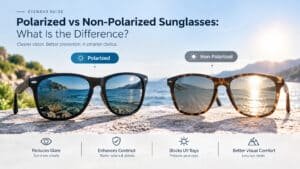
- Polarized lenses
- Logo printing
- Laser engraving
- Custom packaging
- Branded accessories
The goal isn’t simply producing fewer units—it’s helping brands build products with lower financial risk.
Who Is This Service For?
Low MOQ manufacturing is suitable for many different business models.
Startup Eyewear Brands
Many founders want to validate their business idea before investing heavily in inventory.
A smaller production run allows them to collect customer feedback, improve designs, and prepare for future expansion.
Fashion Brands
Clothing brands often introduce sunglasses as an additional product category.
Low MOQ production makes seasonal collections much easier to manage.
Online Retailers
Amazon sellers, Shopify stores, TikTok Shops, and independent eCommerce brands frequently launch limited collections to test market demand.
Smaller production quantities help avoid overstock.
Optical Stores
Independent optical retailers may wish to develop exclusive in-house collections rather than selling only established brands.
Private label eyewear creates stronger customer loyalty.
Custom Eyewear Materials
Not all materials are created equal when it comes to small-batch production. The material you choose dictates your minimum order limits.
1. Cellulose Acetate (The Premium Choice)
Acetate is the king of low MOQ manufacturing. Because acetate frames are CNC-cut from solid sheets rather than injection-molded, there are zero mold fees.
MOQ Reality: We can achieve 300 pieces per model (100 per color) if you select from our factory’s stock acetate colors, including high-end Italian Mazzucchelli options.
Value: Acetate allows for rich tortoiseshell patterns, superior warmth, and the ability for opticians to heat and adjust the frames to the wearer’s face.
2. TR90 (The Lightweight Champion)
TR90 is a thermoplastic material produced via injection molding. It is highly flexible, durable, and lightweight, making it perfect for sports eyewear.
MOQ Reality: Traditional TR90 requires high MOQs (1000+) because creating a new steel mold costs $1,000 – $2,500. However, for low MOQ, you can select from our existing TR90 molds. You bypass the mold fee and only pay for the raw material injection, keeping your MOQ around 100 to 500 pieces.
3. Metal Frames (Stainless Steel & Titanium)
Metal frames require stamping, welding, and electroplating.
MOQ Reality: We can typically process metal frames at 100 pieces per model. The key is using standard bridge and temple components. If you require custom 3D-embossed detailing on the temples, tooling costs will apply.
4. PC (Polycarbonate)
PC is the most cost-effective material, strictly used for budget or fast-fashion sunglasses.
MOQ Reality: PC relies entirely on injection molding. Unless you are using our factory’s existing open molds, custom PC designs require a minimum of 1,200 pieces to justify the tooling costs.
OEM vs ODM Eyewear
Understanding the difference between OEM (Original Equipment Manufacturer) and ODM (Original Design Manufacturer) is critical for controlling your startup costs.
| Feature | OEM (Your Design) | ODM (Factory’s Design + Your Brand) |
| Concept | You provide 3D CAD files; we build from scratch. | You select from our 1,000+ proven styles. |
| Tooling/Mold Costs | High ($500 – $3,000 depending on material). | Zero. The molds already exist. |
| Time to Market | 60 – 90 days (includes prototyping). | 30 – 45 days (direct to bulk production). |
| Best For | Established brands with proprietary designs. | Startups, Boutiques, Fast-fashion brands. |
| MOQ Impact | Hard to do Low MOQ due to sunk tooling costs. | Perfect for Low MOQ (100 pcs). |
B2B Strategy Tip: If you want to launch quickly with minimal risk, choose ODM. We take our best-selling, ergonomically tested frame shapes, inject your chosen stock acetate colors, and laser-engrave your logo. Your customers get a premium product, and you save thousands of dollars in R&D.
Which One Should You Choose?
If you’re entering the market for the first time, ODM can be an efficient way to validate demand.
As your brand grows, OEM development becomes more attractive for creating exclusive collections that strengthen brand identity.
Many successful eyewear companies begin with ODM before gradually introducing OEM products.
Customization Options (Even at Low MOQ)
A low MOQ does not mean a generic product. The “Value Shaping” of your brand happens in the details. Here is how we customize small batches to ensure your brand commands a premium retail price:
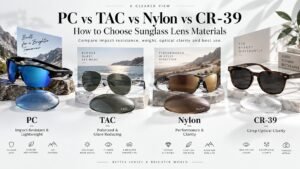
Lens Technology
Don’t settle for cheap acrylic. Upgrade your optics to justify a higher MSRP:
TAC Polarized Lenses: The industry standard for glare reduction. Cost-effective but highly functional.
CR39 Lenses: Half the weight of glass with identical optical clarity. Essential for high-end fashion brands.
Nylon Lenses: Extremely durable and flexible, often used in rimless or luxury metal frames.
Anti-Reflective (AR) & UV400 Coatings: Standard on all Jion Eyewear custom projects.
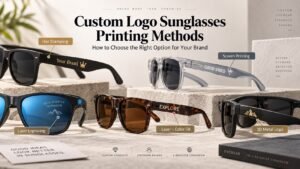
Branding and Logos
Laser Engraving: Clean, subtle, and permanent. Perfect for the inside temples.
Metal Foil (Hot Stamping): Adds a luxurious gold or silver metallic logo on the temples.
Metal Logos (Inlaid): A physical piece of metal embedded into the acetate. Requires slightly higher upfront costs but delivers massive brand authority.
Sample and Bulk Production Timeline
Although timelines vary depending on project complexity, a typical production process follows these stages:

MOQ and Pricing Factors
Various factors can affect the minimum order quantity and pricing for eyewear projects.
Product Structure
More complex frame designs generally require more production steps.
Material Selection
Acetate, titanium, TR90, and PC have different manufacturing costs.
Logo Method
Laser engraving, metal logo inserts, and hot stamping involve different production processes.
Packaging
Custom packaging usually increases production complexity.
Mold Development
Completely new frame designs may require new tooling.
Production Quantity
Larger orders generally reduce unit costs because fixed production expenses are spread across more units.
Rather than focusing only on the lowest possible MOQ, buyers should consider the balance between product quality, branding, inventory planning, and long-term profitability.
Ready to Start Your Project?
Don’t let high MOQs drain your capital. Partner with Jion Eyewear to access premium OEM/ODM manufacturing tailored for growing brands.
👉 [Contact Us via WhatsApp / Email] to get a detailed catalog and a custom quote based on your specific requirements within 24 hours.
Frequently Asked Questions
Can I customize my own logo?
Yes. Logos can typically be added to frames, temples, lenses, packaging, and accessories, depending on the project.
Can I order multiple colors?
In many cases, yes. Color combinations depend on the production plan and order requirements.
Do I need my own design?
Not necessarily.
If you’re launching your first collection, starting with customizable existing designs can simplify development before moving to fully original products.
How long does production take?
Production schedules vary depending on product complexity, customization requirements, and order volume. Confirm the timeline with your manufacturing partner before placing an order.
Can I order samples first?
Yes. Reviewing samples before bulk production helps verify product appearance, fit, and customization details while reducing sourcing risk.