Is your latest eyewear shipment sitting indefinitely in a customs warehouse because it failed fundamental sunglasses regulations? For B2B eyewear brands and wholesalers, ignoring regional compliance standards like the US ANSI Z80.3 or the Australian AS/NZS 1067 is a direct path to profit loss, brand damage, and legal penalties.
B2B buyers do not have the time or capital to gamble on non-compliant inventory. When you import sunglasses into highly regulated markets like the United States or Australia, regulatory bodies demand precise optical performance, rigorous impact resistance, and uncompromising material safety.
This technical guide breaks down exactly what the latest sunglasses regulations require in these key markets. More importantly, it demonstrates how partnering with a certified manufacturer like Jion Eyewear guarantees your products clear customs instantly and perform flawlessly for your end consumers, protecting your bottom line.
The Cost of Ignoring Sunglasses Regulations
Before diving into the specific technical parameters, it is critical to understand the commercial impact of non-compliance. Regulatory bodies classify sunglasses as protective equipment or Class I medical devices. If a random customs inspection reveals that your lenses distort traffic signals or your frames ignite under heat, the consequences are severe:
Immediate Customs Seizure: Your inventory is frozen, destroying your seasonal launch timeline.
Forced Product Recalls: You bear the financial burden of recalling defective units, severely damaging retail partnerships.
Permanent Bans: Serial offenders can be blacklisted by import authorities.
To secure your supply chain, you must manufacture strictly according to the legal frameworks of your target demographic.
Australian Sunglasses Regulations: Navigating AS NZS 1067.1:2016
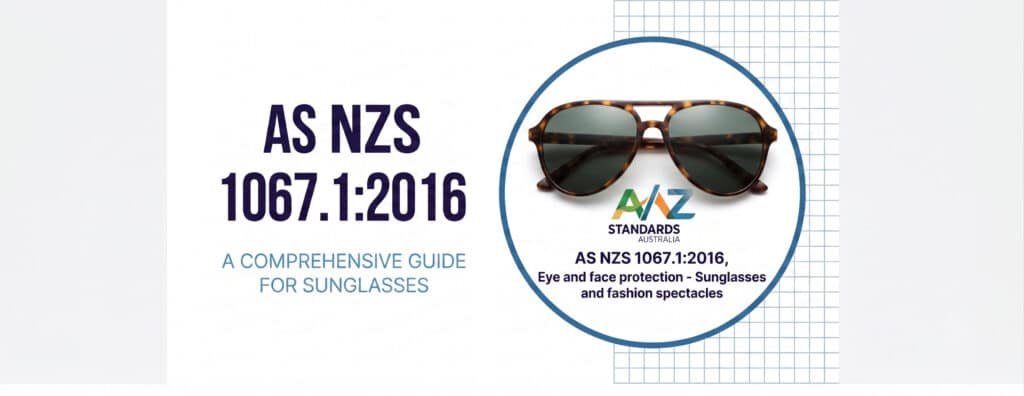
Due to extreme UV radiation levels, Australia enforces some of the strictest sunglasses regulations globally. The standard AS NZS 1067.1 2016 specifically governs sunglasses and fashion spectacles. If you want to penetrate the Australian or New Zealand markets, your inventory must pass these rigorous tests.
1. Zero-Tolerance for Optical Defects
Consumers will instantly return sunglasses that cause eye strain or headaches. The Australian standard requires flawless surface quality. During inspection under fluorescent light , the central 28mm diameter of the visual reference point must be completely free of any flaws.
Your lenses will fail inspection if they contain any of the following defects:
Bubbles, scratches, or inclusions.
Dull spots, pitting, or mould marks.
Water specks, gas inclusions, or polishing defects.
Cracks or splintering.
Furthermore, the refractive power must be precisely calibrated to prevent visual distortion. The spherical power tolerance is strictly limited to ±0.12 , and the astigmatism (cylindrical power) must not exceed 0.09.
2. Strict UV Transmittance and UV400 Claims
Marketers frequently throw around the term “UV400,” but Australian sunglasses regulations demand clinical proof.
To claim UV400 protection, the spectral transmittance in the 190nm to 400nm range must strictly remain under 5.0%.
Manufacturers and brands are explicitly forbidden from making claims with a cutoff wavelength greater than 400nm, meaning marketing a lens as “UV450” is illegal and non-compliant.
3. Traffic Signal Recognition (Crucial for Driving Safety)
Sunglasses must not impair a driver’s ability to distinguish traffic lights. The standard calculates this using an attenuation quotient formula: $Q_{signal}=\frac{\tau_{signal}}{\tau_{v}}$.
To pass, lenses must meet absolute minimum Q-factors for specific colors:
Red signals must have a Q-factor of $\ge 0.8$.
Yellow signals must have a Q-factor of $\ge 0.6$.
Green signals must have a Q-factor of $\ge 0.6$.
Blue signals must have a Q-factor of $\ge 0.7$.
4. Impact Resistance (Strength Level 1)
Australia demands that lenses protect the eye from physical trauma. Under the Level 1 impact resistance test (which is a mandatory requirement), a 16-gram steel ball with a 16mm diameter is dropped directly onto the lens from a height of 1.27 meters. To pass this rigorous standard, the lens must not fracture or shatter upon impact.
US Sunglasses Regulations: A Deep Dive into ANSI Z80.3:2015

For brands looking to dominate the American retail space, the governing standard is ANSI Z80.3:2015, which dictates the requirements for non-prescription sunglasses and fashion eyewear. The FDA strictly references these standards when inspecting imported eyewear.
1. Flammability and Ignition Resistance
A core component of US sunglasses regulations is consumer safety regarding fire hazards.
The flammability test utilizes a 6mm diameter steel rod. The rod can be heated to a peak temperature of 650°C and applied to the frame for 5 seconds. Alternatively, tests may apply a 200°C heat source for 15 minutes. Regardless of the exact protocol phase, the core requirement remains absolute: the eyewear material must not ignite, and if removed from the heat source, it must not continue burning.
2. Severe Corrosion Resistance (Saltwater Testing)
If you are selling sunglasses in coastal US cities like Miami or Los Angeles, metal corrosion is a massive liability that triggers immediate buyer refunds.
The ANSI Z80.3 standard simulates extreme coastal wear through a brutal salt bath test. The entire pair of sunglasses is submerged and boiled in a 10% salt solution for 15 minutes, after which it is removed and dried at room temperature for a full 24 hours. Following this extreme exposure, absolutely no metal components may exhibit signs of corrosion, and all parts of the sunglasses must maintain their full structural functionality.
3. Refractive Tolerances and Polarization Precision
Similar to Australia, the US enforces strict optical clarity rules to prevent consumer nausea.
Refractive Power: The spherical power tolerance is limited to ±0.13. The astigmatism tolerance is capped at 0.13. Prism power is also tightly controlled, limited to 0.50 in the horizontal direction and 0.25 in the vertical direction.
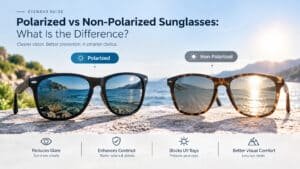
Polarized Lenses: Misaligned polarization creates severe optical distortion. The US standard mandates that the axis of polarization cannot deviate from the vertical (or otherwise specified direction) by more than ±3°.
Beyond Lenses: Global Frame Endurance Standards
While regional regulations heavily target lens safety, premium B2B buyers must also ensure the frame itself can withstand daily abuse. Under comprehensive testing standards like EN ISO 12870 (which applies to basic requirements and test methods for spectacle frames), frames must prove their mechanical superiority.
Endurance and Fatigue: Frames are subjected to a brutal 500-cycle folding and unfolding test. After 500 cycles, the frame must exhibit zero fractures , and any permanent deformation cannot exceed 5mm.
Sweat Corrosion: Frames are locked in an artificial sweat vapor environment at 55°C. After 8 hours, the frame must show zero spots or color changes. After a full 24 hours, there must be absolutely no corrosion or peeling of the surface coating.
High-Temperature Stability: Nobody wants a frame that warps when left on a car dashboard. Frames are placed in a 55°C heating chamber for 2 hours. The dimensional change (the distance between the temple ends) is strictly limited to a variance of +6mm or -12mm.
How Jion Eyewear Protects Your Business and Accelerates Growth
Understanding these dense sunglasses regulations is a full-time job. As a brand owner or wholesaler, your time should be spent on marketing and distribution, not worrying about whether your factory properly executed a 10% saltwater boiling test or if your lenses passed the 1.27-meter drop ball requirement.
At Jion Eyewear, compliance is deeply integrated into our manufacturing DNA. Every product that leaves our facility is engineered to seamlessly pass US ANSI Z80.3, Australian AS/NZS 1067.1, and European CE standards. This means you can confidently sell in your local market without fear of customs seizures, regulatory fines, or costly customer returns.
We combine this uncompromising regulatory compliance with highly flexible, business-friendly manufacturing solutions tailored to both startups and established brands:
1. Light Customization (Speed to Market)
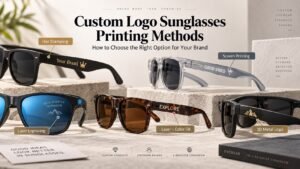
Launch your brand faster without sacrificing compliance. Our Light Customization program allows you to utilize our pre-tested, regulation-compliant molds. You can easily swap out frame colors, temple designs, and lens tints to match your brand aesthetic. We support extensive branding options, allowing you to add your custom logo via laser engraving, silk printing, hot stamping, or premium metal applications.
2. Full Customization (End-to-End OEM/ODM)
If you want to disrupt the market with a completely unique silhouette, our Full Customization service is the answer. You simply provide us with a design sketch. Our expert engineering team will help you select the optimal materials (ensuring they meet strict flammability and endurance standards) and bring your exact vision to life, handling everything from 3D CAD modeling to final compliance testing.
3. Data-Driven Market Intelligence
Stop guessing what inventory to stock. At Jion Eyewear, we don’t just manufacture; we act as your strategic growth partner. We provide localized market intelligence, analyzing purchasing trends specific to your region (whether you are selling in California, Sydney, or London). We help you pinpoint exactly which frame shapes and lens colors are currently dominating your market, ensuring your compliant eyewear is also highly profitable.
Secure Your Supply Chain Today
Do not risk your brand’s reputation on non-compliant suppliers. Partner with a manufacturer that understands the critical importance of US and Australian sunglasses regulations.
Ready to launch a customized, fully compliant eyewear collection? Visit our website at Jion Eyewear or Contact Our B2B sales team today. We will provide you with a comprehensive, competitively priced manufacturing proposal that guarantees your products clear customs and captivate your customers.