Starting an eyewear brand requires more than choosing attractive frames. You need to define your target customer, select a focused product range, choose between private label, ODM, and OEM, develop samples, confirm materials and customization, check market requirements, and plan production. The practical path is to validate the product before committing to large inventory. Your manufacturer should help turn a clear product brief into an approved sample, controlled production order, and retail-ready shipment.
Define Your Target Customer and Eyewear Niche
Before contacting an eyewear manufacturer, decide who will buy your products and why.
A startup brand usually has more risk when it launches too many unrelated styles. A narrower product direction makes product development, sampling, packaging, and marketing easier to control.
Your niche should answer four questions:
- Who is the wearer?
- What problem or style preference does the product address?
- What retail price level are you targeting?
- Where will the products be sold?
Jion Eyewear works with sunglasses, optical frames, sports eyewear, safety eyewear, blue light glasses, and reading glasses, giving emerging brands several starting points.
Fashion Sunglasses
Fashion sunglasses are suitable for brands selling primarily through lifestyle, fashion, online, boutique, and independent retail channels.
The main product decision is usually design rather than technical performance. Frame shape, color, lens tint, logo placement, and packaging can strongly influence the final retail appearance.
For a startup, an existing frame with private label customization can reduce development complexity compared with creating a completely new mold.
Optical Frames
Optical frames are more suitable when your brand is connected to prescription eyewear, optical stores, or professional eyewear retail.
Frame dimensions become particularly important. Your product brief should include eye size, bridge size, temple length, frame width, and other relevant dimensions.
Materials can include acetate, TR90, PC, and metal. Jion Eyewear currently offers acetate, TR90, and metal optical frame categories.
Sports or Safety Eyewear
Sports and safety products require more attention to product use and testing requirements.
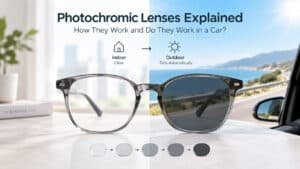
Sports eyewear may need considerations such as wraparound geometry, lens material, retention, polarization, or photochromic options.
Safety eyewear is a different category. You should define the actual workplace hazard and target market before requesting a quote. Do not assume that a standard fashion sunglasses design can simply become safety eyewear through a different lens.
Blue Light or Sleep-focused Eyewear
Blue light and sleep-focused eyewear can work for brands targeting screen users, office workers, wellness customers, or specific lifestyle segments.
The product brief should clearly state the intended use rather than relying only on terms such as “blue light” or “sleep glasses.” If a specific optical performance claim will be used in marketing, confirm the applicable testing and evidence before production.

Choose Private Label, ODM or OEM
The manufacturing model affects development cost, tooling, customization, MOQ, and project complexity.
| Factor | Private Label | ODM | OEM |
|---|---|---|---|
| Design ownership | Manufacturer’s existing model | Manufacturer’s base/design adapted to buyer needs | Buyer’s original design |
| Customization | Logo, colors, packaging and selected details | Shape, materials, colors, components and branding depending on project | Full design according to approved specifications |
| Tooling | Usually existing tooling | Existing tooling or new tooling depending on modification | Usually new tooling or custom production development |
| MOQ | Usually lower or more flexible | Depends on modifications | Project-dependent |
| Development time | Shortest | Medium | Longest |
| Best for | Market testing and startups | Brands wanting differentiation without starting from zero | Brands with proprietary product designs |
Jion Eyewear supports private label, OEM, and ODM projects. Existing models can be customized with branding and packaging, while custom mold development can be evaluated for more original designs.
If you want a deeper explanation of the differences, see Jion Eyewear’s OEM vs ODM Eyewear Manufacturing guide.
For an existing-model launch, also review the site’s Private Label Eyewear service if available on your site structure.
The important point is not choosing the model that sounds more customized. Choose the manufacturing model that matches your budget, design ownership, and expected sales volume.
Build a Realistic Startup Budget
The first eyewear budget should separate development costs from inventory costs.
Do not ask only, “How much does one pair cost?” A manufacturer needs to know the product specification before the commercial cost can be calculated.
| Cost Item | Budget Basis |
| Samples | Quoted by project |
| Tooling / molds | Quoted by project |
| Frames / lenses | Depends on material, specification and quantity |
| Logo | Quoted by project |
| Packaging | Depends on packaging design and quantity |
| Testing | Quoted by project and required market |
| Shipping | Depends on destination, method and shipment size |
We do not publish a universal price list for these project variables. Custom mold development, materials, product specifications, and quantities are evaluated according to the individual project. We can only assess manufacturing feasibility, the exact minimum order quantity (MOQ), and tooling costs after receiving the design specifications.
For a startup, separate your budget into three stages:
- Development: samples, design work, tooling, and testing.
- Production: frames, lenses, logos, packaging, and other components.
- Logistics: freight, customs-related costs, and final delivery.
This approach prevents a common mistake: spending the entire budget on the first production run and having no cash left to reorder a product that sells well.
Select Frame and Lens Materials
Material selection should follow the product’s positioning and use case.
Acetate, TR90, PC and metal frame considerations
Acetate is commonly considered when the brand needs a more substantial frame appearance, color depth, and a design-led positioning.
TR90 is useful when lightweight construction and flexibility are important. It is often considered for optical, sports, and active-use products.
PC is useful for lightweight molded designs and can support certain sports and fashion constructions.
Metal can provide a different visual language and is often used for optical frames and fashion-oriented designs.
Jion Eyewear lists Acetate, TR90, Metal, and PC among its frame manufacturing materials.
Lens material, UV, polarization and coatings
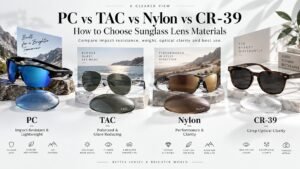
The common lens materials we offer include PC, TAC, CR39, and nylon. The specific material choice depends on the product design and intended use.
For sunglasses, buyers may need to specify:
- UV protection requirement
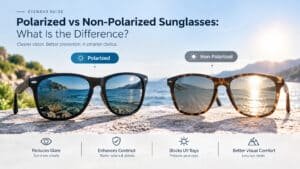
- Polarized or non-polarized lens
- Lens color
- Mirror coating
- Anti-scratch treatment
- Target market requirements
For example, TAC polarized lenses may make sense for sunglasses designed around glare reduction, while PC can be considered where impact resistance and lightweight construction are important.
Do not treat “UV400,” “polarized,” or “impact-resistant” as interchangeable marketing terms. Confirm the exact specification and applicable test method before using a performance claim.
Brand Positioning → Use Scenario → Material Selection
| Brand positioning / use scenario | Materials to consider | Main reason to evaluate |
| Fashion-focused sunglasses | Acetate, PC, Metal | Shape, color, styling and retail appearance |
| Lightweight everyday optical frames | TR90, PC, Metal | Weight, comfort and frame construction |
| Premium-looking optical collection | Acetate, Metal | Material appearance and design |
| Sports sunglasses | PC, TR90 | Lightweight construction and active-use design |
| Safety eyewear | PC, TR90 and application-specific materials | Product structure and applicable performance requirements |
| Blue light glasses | TR90, PC, Acetate, Metal | Comfort, styling and lens specification |
| Sleep-focused eyewear | Depends on product design | Lens specification and intended optical claim |
Prepare a Product Brief
A clear product brief saves time during quotation and sample development.
At minimum, send:
Reference Images: Front, side, and detail shots (or CAD files).
Dimensions: Lens width, bridge width, temple length.
Materials: Frame material type and lens specifications.
Colorways: Specific Pantone codes or acetate swatch references.
Branding: Logo design files (AI/EPS), exact placement, and application method (e.g., gold hot stamping on the left temple).
Packaging: Requirements for cases, cloths, and outer boxes.
Target Market: Where you intend to sell (to address CE/FDA standards).
Quantity: Target MOQ per color and style.
Target Lead Time: Your expected launch date.

Develop and Approve Samples
Sampling is where the product specification becomes a physical product.
We describe our process as requirement and design confirmation, sample production and approval, followed by mass production and quality control.
A practical sample sequence is:
Design confirmation → Material and color confirmation → Prototype → Fitting and inspection → Revision → Golden sample
Design confirmation
Confirm the frame shape, dimensions, logo location, lens specification, and construction before production starts.
Material and color confirmation
Do not approve colors only from a screen image. Confirm the actual material and color reference where necessary.
Prototype
The manufacturer produces a physical sample based on the agreed specifications.
Fitting and inspection
Check:
- Frame dimensions
- Alignment
- Hinge movement
- Lens fitting
- Surface finish
- Logo position
- Wearing comfort
- Packaging fit where relevant
Revision
Record every change. Avoid approving a sample while changes are still being discussed through scattered messages.
Golden sample
The final approved sample becomes the physical reference for bulk production.
For a detailed explanation, see the Eyewear Sample Development Process guide.

Understand MOQ and Production Trade-Offs
MOQ is not simply a factory number.
The required quantity can change depending on how many variables must be prepared for production.
| Factor | Possible MOQ Impact |
| Number of frame colors | More colors can divide the total quantity across more production combinations |
| Material | Special materials or sheet requirements may affect production quantities |
| New mold | Tooling investment can make very small orders less practical |
| Packaging | Custom packaging may require separate quantity commitments |
| Lens type | Special lens materials, colors or coatings can change production requirements |
| Logo method | Different printing, engraving or hardware processes have different setup requirements |
| Total order quantity | Larger consolidated orders can make customization more practical |
Jion Eyewear positions flexible, startup-friendly MOQs as part of its manufacturing service and states that precise MOQs are evaluated according to project specifications.
This is why asking only “What is your MOQ?” often produces an incomplete answer.
For a deeper explanation of the variables, review Jion Eyewear’s Low MOQ Custom Eyewear Manufacturing Guide.
Plan Testing and Market Requirements
Eyewear is regulated. Before production begins, clearly state your target market so the factory applies the correct compliance markings.
For general-use sunglasses, ISO 12312-1:2022 covers afocal sunglasses and clip-ons intended for general use and solar-radiation protection.
For U.S. occupational and educational eye protection, ANSI/ISEA Z87.1-2025 is the current ANSI safety eyewear standard listed by ANSI. It addresses requirements, testing, permanent marking, selection, care, and use.
The key point is that the product category determines which requirements may apply.
A fashion sunglasses project should not automatically be treated as occupational PPE. Similarly, a safety eyewear project should not rely on a general sunglasses specification.
Please ensure you fully understand the specific requirements applicable to the finished product and the target market. If you are unclear about the compliance requirements in your region, you may also consult us.
Note: All regulatory standards are subject to change based on official government guidelines. Buyers and independent laboratories must confirm the specific applicability of these standards prior to mass shipment.
Confirm Production, Quality Checks and Packaging
Once your Golden Sample is approved, mass production begins. Before the factory ships your final inventory, verify the following via a pre-shipment inspection checklist:
Approved Golden Sample Match: Ensure bulk units perfectly match the weight, color, and finish of the signed sample.
Spec Sheet Accuracy: Measure lens width and temple length using digital calipers.
Color Standard: Check under standardized lighting to ensure no dye batch variations.
Logo Placement: Verify logo alignment, sharpness, and resistance to scratching.
Packaging Alignment: Ensure frames fit securely inside custom cases without rattling or bending.
Build a Practical Launch Timeline
The launch timeline depends heavily on whether you are using an existing model, modifying an existing design, or developing a new product.
Manufacturing content references approximately 45 days for plastic sunglasses production and 75–90 days for acetate eyewear manufacturing, showing why material and construction can materially change the production schedule. These figures should be treated as project references, not universal delivery promises.
A practical planning framework is:
| Stage | Typical Planning Range | Main Output |
| Brief | 1–3 days | Product requirements |
| Quotation | 2–7 days | Cost and MOQ proposal |
| Sample | Project-dependent | Physical prototype |
| Revision | Project-dependent | Updated sample |
| Approval | 1–7 days | Golden sample |
| Production | About 45 days for some plastic projects; 75–90 days for some acetate projects | Bulk goods |
| Inspection | Before shipment | Inspection result |
| Shipping | Depends on destination and method | Delivered inventory |
These are planning ranges rather than fixed promises. New molds, multiple colors, special lenses, complex logos, packaging development, testing, revisions, and production scheduling can extend the project.
The safest approach is to build your launch date backward from the required stock-arrival date.
What to Send a Manufacturer for a Useful Quote
A manufacturer can quote much more accurately when you provide the core product information in one message.
Send these eight items:
- Product type — sunglasses, optical frames, sports, safety, blue light, or another category.
- Reference images or drawings — show the intended shape and construction.
- Frame material — such as acetate, TR90, PC, or metal.
- Lens specification — material, color, polarization, coatings, and intended function.
- Customization — logo position, logo method, frame colors, lens colors, and packaging.
- Quantity — total quantity and, if applicable, quantity per color.
- Target market — country and intended sales application.
- Target delivery date — when the goods need to arrive.
If you already have a technical drawing or tech pack, send it with the reference images.
If you do not have a complete design, that is also useful information. We can first determine whether an existing model, ODM modification, or new OEM development is more practical.
FAQ
1. How much does it cost to start an eyewear brand?
There is no fixed cost. Your budget depends on the frame, lens, quantity, customization, tooling, packaging, testing, and shipping. Ask the manufacturer for a project-based quotation.
2. What MOQ do I need to start an eyewear brand?
MOQ depends on the product and customization. Frame material, colors, lenses, molds, logo methods, and packaging can all affect MOQ. Confirm the MOQ for your exact specifications.
3. Should I choose Private Label, ODM, or OEM?
Private Label is suitable for testing existing styles. ODM is better when you want to modify an existing design. OEM is suitable when you have your own original design and need custom development.
4. How long does it take to develop and produce eyewear?
The timeline depends on the product and development requirements. Existing models are usually simpler, while new molds, special materials, testing, and multiple revisions can take longer. Confirm the sample and production schedule before ordering.
5. What should I send to an eyewear manufacturer for a quotation?
Send your product type, reference images, frame and lens materials, colors, logo requirements, packaging, estimated quantity, target market, and target delivery date. This gives the manufacturer enough information to evaluate the project.
Ready to discuss your first collection?
Send your product type, reference images, frame and lens preferences, logo requirements, target quantity, target market, and desired delivery date.
Jion Eyewear can evaluate the project and provide the relevant MOQ, tooling, and quotation details.