A custom glasses case should not start with your logo. It should start with the glasses that need to fit inside it.
Before asking a supplier for colors, logo methods or prices, define five things first: the eyewear dimensions, how the customer will use the case, your retail positioning, target packaging cost and expected order quantity.
This sequence matters because a premium-looking case that presses against the lenses, wastes shipping space or costs too much for your retail price is still the wrong case.
For eyewear brands, the better sourcing sequence is:
Eyewear → Fit → Case Structure → Material → Branding → Packaging System
That approach reduces sample revisions and makes it easier to compare quotations from different suppliers.
What Should You Decide Before Ordering a Custom Glasses Case?
Start by answering one commercial question: What job does the case need to do for this eyewear collection?
A $20 fashion sunglass collection, a premium acetate optical line and a technical sports eyewear range should not automatically use the same case.
A lower-priced promotional collection may only need a simple pouch or standard case with a printed logo. A premium optical frame may justify a rigid wrapped case with a soft lining, while wraparound sports sunglasses may require a deeper EVA shell.
The case also affects how customers perceive the product before they even wear the glasses.
For that reason, send your supplier more than a logo file. Provide the eyewear model, frame dimensions, product photos, target market, estimated quantity, target positioning and preferred packaging style.
If you are developing both the eyewear and its packaging, it is generally more efficient to treat the eyewear case as part of the overall OEM/ODM customization project, rather than waiting until the last minute to source it separately.
Start With the Glasses — Not the Case Design
One of the most common buyer questions is:
“How do I know whether this case will actually fit my glasses?”
Do not judge this from the outside dimensions of the case.
What matters is the usable internal space after the lining, hinges, zipper construction or internal supports have been added.
Three eyewear dimensions deserve particular attention.
The first is overall frame width. A wide acetate frame may fit into a standard case visually but become difficult to remove if there is almost no side clearance.
The second is folded height and thickness. Thick acetate temples, spring hinges, decorative temples and stacked temple tips can require considerably more internal depth than a thin metal optical frame.
The third is frame curvature. Wraparound sports sunglasses are the best example. Their curved lens geometry can create a much deeper product profile even when the nominal frame width looks similar to a conventional sunglass frame.
This is why approving a case from a drawing alone creates unnecessary risk.
For a new case project, ask the supplier to test an actual production or approved eyewear sample inside the proposed case. Check that the temples close naturally, the lenses do not contact a hard internal surface and the frame can be inserted and removed without force.
Buyer rule: approve the case with the actual eyewear, not only with dimensions on a specification sheet.

Which Type of Custom Glasses Case Should You Choose?
There is no universally “best” glasses case. The right structure depends on protection requirements, retail positioning, logistics and target cost.
Case Type | Best For | Main Benefit | Buyer Watch-Out |
EVA hard-shell case | Sports, outdoor and larger sunglasses | Lightweight protection and flexible shape development | Custom shapes may require tooling |
Rigid wrapped case | Optical and premium fashion collections | Strong presentation and large branding surface | More volume can increase packing and freight |
Metal clamshell case | Classic optical and premium collections | Slim structure with a solid feel | Check hinge action, lining and surface finishing |
Folding case | Fashion and e-commerce brands | Can reduce storage and shipping volume | Confirm stability after repeated folding |
Microfiber pouch | Entry-level, promotional or secondary packaging | Lightweight and low-volume | Limited impact protection |
Drawstring or fabric pouch | Lifestyle and casual collections | Flexible branding and material options | Fabric thickness and stitching quality matter |
EVA Cases: Practical for Sport and Travel
EVA cases work well when you need a lightweight protective shell without the weight of a traditional metal structure.
They are especially useful for sports sunglasses because deeper or more curved interiors can accommodate wraparound frames.
But “EVA case” does not describe one fixed quality level. Buyers should still confirm shell thickness, zipper quality, lining, edge finishing and the actual fit around the frame.
Rigid Wrapped Cases: Better for Brand Presentation
A rigid core wrapped with PU, fabric or another surface material gives brands more control over texture, color and logo presentation.
This route is useful when the case is part of the retail experience rather than simply transportation protection.
The trade-off is volume. A beautiful oversized case may look premium individually but become inefficient once hundreds or thousands are packed into export cartons.
Folding Cases: Useful When Logistics Matter
Folding structures can be particularly attractive to e-commerce brands and international buyers because the case occupies less volume before final assembly or use.
This illustrates an important sourcing principle: unit price is not the only packaging cost.
A slightly more expensive structure that significantly improves carton utilization may produce a better landed-cost result than a cheaper but bulky rigid case.

How to Choose the Right Material for a Custom Glasses Case
Material should support both the product position and the way the case will be used.
PU and Synthetic Leather Finishes
PU-wrapped cases are popular because they offer a broad range of colors and surface textures while supporting processes such as foil stamping, embossing and printing.
They are suitable for fashion and optical brands wanting a cleaner retail presentation without moving into genuine leather.
However, buyers should avoid assuming that all PU finishes are equivalent. Surface texture, thickness, backing material and resistance to abrasion can vary.
EVA
EVA provides structure with relatively low weight and is well suited to zippered protective cases.
For sports and travel eyewear, its main commercial advantage is not simply the material itself. It is the ability to create a protective case around a more three-dimensional frame shape without making the package excessively heavy.
Metal
Metal shells create a firm and relatively slim structure, making them suitable for classic optical products.
The shell is only one part of the quality assessment. Buyers should also inspect the spring or hinge action, surface coating, edge finishing and interior lining.
A strong outer shell does not help if the inside creates pressure points against the frame.
Microfiber and Textile Materials
Microfiber is often used for pouches and internal linings because it provides a soft surface around eyewear.
For branded pouches, check fabric weight, stitching, drawstring construction, logo definition and color consistency.
A pouch can also serve two functions: secondary protection and lens-cleaning convenience, depending on the fabric specification.
Paperboard and Paper-Based Packaging
Paper-based components are more relevant when the case is integrated into a complete retail packaging system.
If a brand wants to make responsible-sourcing claims around paper or cardboard, certification should be verified rather than assumed. FSC Chain of Custody certification is designed to track eligible forest-based materials through processing and distribution.
Likewise, avoid placing vague terms such as “green” or “eco-friendly” on packaging without evidence. The U.S. Federal Trade Commission advises marketers to substantiate environmental claims and clearly qualify claims relating to recycled content or recyclability.
Commercial conclusion: choose a material because it supports your product position and verified brand claim—not because the material name sounds premium or sustainable.

Custom Logo Options: Which Branding Method Works Best?
Your logo technique should be selected after the case material.
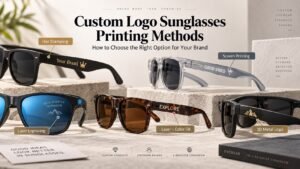
Logo Method | Visual Effect | Suitable Applications | Main Consideration |
Silk-screen printing | Clean, simple color | Fabric, PU and flat surfaces | Best for relatively simple artwork |
Hot foil stamping | Metallic premium finish | PU and wrapped rigid cases | Check foil color and adhesion |
Debossing | Subtle recessed branding | PU and leather-like surfaces | Elegant but less visible from distance |
Embossing | Raised tactile branding | Suitable wrapped surfaces | Tooling may be required |
Metal badge | Strong premium identity | Rigid premium cases | Higher component and assembly cost |
Laser engraving | Precise permanent mark | Suitable metal or compatible surfaces | Appearance depends heavily on base material |
Do not select the most expensive logo process automatically.
A luxury-style gold foil logo can work well on a restrained black rigid case, while the same effect may look inconsistent with a technical sports product.
For performance eyewear, a smaller one-color logo on an EVA case can communicate the brand more effectively.
The goal is not maximum decoration. The goal is consistent brand positioning.

What Can Be Customized Beyond the Logo?
A good custom glasses case project can go much further than printing a brand name.
Depending on the structure, buyers can customize the outer color, lining color, surface texture, zipper and zipper pull, stitching, case dimensions, molded shape, internal supports, magnetic closure, fabric, print pattern and packaging labels.
But every additional custom element creates another specification that must be controlled.
For example, requesting a Pantone-matched exterior, matching zipper tape, custom zipper pull and matching microfiber cloth may create a stronger branded set. It also introduces four separate color or component approvals.
The practical approach is to customize the details customers notice most first.
For a growing brand, case color + logo + cloth + retail box often creates more recognizable brand value than redesigning every hidden component.
MOQ and Cost: What Actually Changes the Price?
There is no meaningful universal answer to “What is the MOQ for custom glasses cases?”
MOQ changes with the production route.
Using an existing case structure with a standard material and adding a logo usually creates the lowest development barrier.
Changing the exterior color or lining normally requires more material coordination.
Creating a completely new size, molded EVA shell, special hardware or proprietary structure can add tooling and increase the practical production quantity.
The same principle applies to pricing.
The main cost drivers are case structure, dimensions, shell material, exterior finish, lining, logo process, hardware, tooling, individual packaging and total quantity.
Larger volumes generally reduce the impact of setup expenses because fixed preparation costs are spread across more units. But ordering more purely to obtain a lower case price is not always the better commercial decision.
For a new eyewear collection, excess packaging inventory is still inventory.
A better quotation request therefore asks the supplier for multiple quantity scenarios.
For example, compare a market-test quantity, a standard production quantity and a higher-volume reorder quantity. This allows you to evaluate unit cost against inventory exposure instead of chasing the lowest possible unit price.
The same sourcing logic applies to private-label eyewear itself: customization level and production method should be defined before the final MOQ and quotation are evaluated. See our private label sunglasses sourcing guide for the same approach on frames and lenses.

Should You Customize Only the Glasses Case or the Complete Eyewear Packaging Set?
For many brands, the better question is not “Which case should we order?”
It is:
“What should the customer receive when they open the product?”
A complete eyewear packaging system may include the glasses case, microfiber cloth, pouch, retail box, instruction or warranty card, barcode label and shipping packaging.
Designing these items separately can create unnecessary problems. The case may not fit efficiently inside the box. The box may require excessive filler. Brand colors may vary between suppliers. The combined package may also become much larger than necessary.
This matters increasingly for brands selling into Europe.
The EU Packaging and Packaging Waste Regulation, Regulation (EU) 2025/40, began applying from 12 August 2026. It includes packaging sustainability requirements and a packaging-minimisation direction; Article 10 requires manufacturers or importers, by 1 January 2030, to reduce packaging weight and volume to the minimum necessary for functionality.
That does not mean every eyewear brand should immediately choose the smallest possible case. Protection, functionality and presentation still matter.
It does mean that oversized packaging simply to create perceived value is becoming a weaker packaging strategy.
For buyers developing new European collections, a compact case-and-box system is worth considering from the beginning.
Always Test Samples Before Bulk Production
A custom glasses case sample should answer more than “Does the logo look correct?”
First, test fit. Put the actual glasses inside, close the case completely and check whether the frame or lenses contact hard internal surfaces.
Next, evaluate daily use. Open and close the case repeatedly. Check the zipper, hinge or magnetic closure and observe whether the lining shifts.
Then review the branding under normal retail lighting. Confirm logo size, position, color, foil definition and alignment.
Finally, test the complete retail packaging—not only the individual case.
For larger orders, packaging performance during transportation also deserves attention. ISO 2248 covers vertical impact testing of complete, filled transport packages, while ISO 2247 addresses low-frequency vibration testing. These are transport-package standards rather than “glasses case certifications,” but they illustrate why protection should be evaluated on the complete packed system when shipping damage is a concern.
A pre-production sample should therefore become the reference standard for bulk production.
Do not approve with comments such as “make the logo a little smaller.”
Approve measurable specifications.
Frequently Asked Questions About Custom Glasses Cases
What information should I send to get an accurate custom glasses case quotation?
Send the eyewear model or sample, frame dimensions, case type, preferred material, logo file, logo method if known, colors, required quantity, target market and any additional packaging requirements.
The clearer the specification, the easier it is to compare quotations fairly.
Can I add my logo to an existing glasses case instead of creating a new case?
Yes. For many new brands, this is the most practical starting point.
Using an existing case structure and customizing the logo, color or lining can reduce development complexity compared with creating a completely new structure.
What logo file should I provide?
Vector artwork such as AI, EPS or editable PDF is generally preferable because it allows the logo to be scaled without losing definition.
Also provide Pantone references or other defined color standards when color accuracy matters.
How do I know whether a case will fit oversized or wraparound sunglasses?
Do not rely only on frame width.
Send an actual eyewear sample or complete three-dimensional dimensions and ask the supplier to verify the internal usable space. Wraparound curvature, temple thickness and folded depth can all affect fit.
Should I order a custom sample before bulk production?
For a new structure, material, color combination or branding method, yes.
A physical sample allows you to inspect fit, logo quality, surface finish, closure performance and the relationship between the glasses, case and retail box before committing to bulk production.
Should the glasses case and eyewear be sourced from the same supplier?
Not necessarily, but combining development can simplify fit testing, color coordination, sample approval and final packing.
If different suppliers are used, create one packaging specification containing the approved dimensions, materials, colors, logo artwork and reference samples so that responsibility is clear.
Conclusion: Build the Case Around the Glasses and the Brand
A successful custom glasses case project starts with the eyewear—not with the logo.
Confirm the frame dimensions and product positioning first. Then select the case structure, material and branding method. After that, evaluate MOQ, tooling, packaging cost and the complete retail presentation.
The order matters.
A case that fits correctly, supports the intended retail price and works efficiently inside the full packaging system adds real value to the product. An oversized or over-designed case only adds cost.
If you are developing a new eyewear collection, send us your eyewear photos or sample, frame dimensions, logo file, target quantity and preferred packaging style.
We can help you compare different case structures and branding routes before you commit to bulk production.
Planning a new collection? Request 3 packaging options—cost-focused, balanced and premium—so you can compare the right case for your target retail price before placing your order.