When developing a new eyewear collection, choosing the right frame material directly affects your product positioning, manufacturing cost, customization possibilities, and customer experience.
For eyewear brands, designers, and sourcing managers, the decision between acetate vs CP eyewear is not simply about appearance. It is about selecting a material that matches your target market, sales channel, and brand strategy.
Acetate frames are often selected for premium eyewear collections because of their rich colors, unique patterns, and customization potential. CP (cellulose propionate) frames are widely used for commercial eyewear because they offer lightweight performance and cost-effective production.
As an OEM and ODM eyewear supplier, Jioneyewear helps brands evaluate different materials based on their market goals, product positioning, and production requirements.
This guide explains the key differences between acetate and CP eyewear from a manufacturing and business perspective.
What Is Acetate Eyewear?
When premium eyewear brands talk about quality, they are usually talking about acetate. It is the gold standard for independent designers and luxury labels.
What Is Cellulose Acetate?
Cellulose acetate is a plant-based plastic derived from cotton linters and wood pulp. Unlike standard petroleum-based plastics, acetate is formed into solid blocks or sheets rather than being melted and injected into a mold. At Jioneyewear, we frequently work with premium suppliers like Mazzucchelli to source high-grade acetate sheets that offer unparalleled depth of color.
Advantages of Acetate Frames
1. Premium Appearance and Luxury Feel
Acetate has a natural, warm, and glass-like transparency that cannot be perfectly replicated by cheaper plastics. When a customer holds an acetate frame, the density and tactile feel immediately signal high value, justifying a higher retail price point.
2. Superior Customization Options
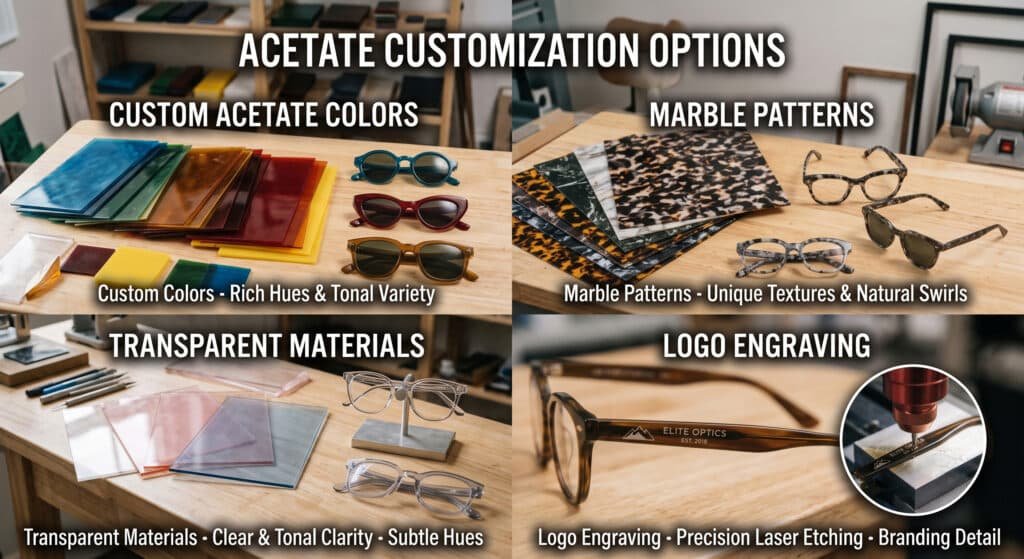
Because acetate frames are cut from solid sheets via CNC machining, they offer incredible flexibility for small-batch custom eyewear manufacturers. Acetate allows brands to customize:
Material: Sourcing custom acetate sheets with proprietary Havana or tortoiseshell patterns.
Frame Design: Creating sharp geometric edges or thick, bold profiles (like the classic chunky square frames).
3. Better Long-Term Durability
Acetate is hypoallergenic and highly flexible. During manufacturing, we insert a metal wire core into the temples. This not only reinforces the frame but allows opticians to heat and adjust the glasses for a perfect fit without snapping the material.
Disadvantages of Acetate Frames
Higher Production Cost: The raw material is expensive, and the machining and hand-polishing processes are labor-intensive.
Longer Manufacturing Time: Achieving the perfect gloss requires tumbling the frames in wood chips for up to 7 days.
Heavier Weight: Thick acetate frames can be heavy, which might not suit brands focused on ultralight sports eyewear.
What Is CP Eyewear?
If your business model relies on high volume and competitive retail pricing, CP is likely on your radar.
What Is Cellulose Propionate (CP)?
Cellulose propionate (CP) is a lightweight thermoplastic material commonly used in optical frames and sunglasses.
Compared with acetate, CP is usually produced through injection molding, which allows efficient manufacturing for larger-volume production.
Because of its lightweight characteristics and production efficiency, CP frames are widely used in commercial eyewear markets.
Advantages of CP Frames
Cost-Effective for Mass Production: Once the initial mold is created, the unit cost per frame drops significantly. This makes CP an excellent choice for mass-market brands or promotional eyewear.
Lightweight Comfort: CP is noticeably lighter than acetate, making it ideal for everyday prescription glasses or activewear.
Fast Manufacturing Times: Injection molding can produce thousands of frames in the time it takes to CNC-cut and polish a single batch of acetate glasses.
Disadvantages of CP Frames
High Initial Tooling Cost: If you want a custom shape, you must pay for a new injection mold (tooling), which can be expensive upfront.
Surface-Level Coloring: Unlike acetate, where the pattern is embedded inside the material, CP frames are usually spray-painted or coated. Over time, this top coat can chip or fade with sweat and UV exposure.
How to Identify Acetate and CP Eyewear Before Ordering
Acetate and CP (cellulose propionate) eyewear share several common characteristics; for instance, both use relatively soft materials and require metal cores in the temples. Furthermore, because CP is widely known as ‘imitation acetate,’ it frequently serves as an alternative to traditional acetate eyewear.
For many buyers, identifying acetate and CP eyewear is not always easy during product evaluation.
In fact, a more practical way is to check the nose pad area.
In many cases:
Acetate Eyewear
Acetate frames usually use transparent nose pads.
Because acetate material has a natural premium appearance and is often designed with visible material layers and patterns, manufacturers commonly use transparent nose pads to maintain a cleaner and more refined appearance.
CP Eyewear
CP frames often use nose pads that match the frame color.
The nose pad color is usually closer to the overall frame appearance, creating a more uniform visual effect.

Acetate vs CP Eyewear: Key Differences
To help you make a fast procurement decision, here is how the two materials compare on the factory floor:
| Feature | Acetate | CP |
| Material Type | Cellulose acetate (Sheet cut) | Cellulose propionate (Injection molded) |
| Positioning | Premium / Luxury | Commercial / Mass-market |
| Appearance | Deep luxury texture, embedded patterns | Standard appearance, painted surface |
| Weight | Medium to Heavy | Lightweight |
| Durability | Excellent (Adjustable with metal core) | Good (Prone to surface wear) |
| Customization | High (Low MOQ for shape changes) | Medium (Requires new mold for shape changes) |
| Production Cost | Higher unit cost | Lower unit cost (at high volume) |
| Manufacturing Time | Longer (Hand-polished) | Faster (Machine output) |
| Best For | Premium independent brands, boutique labels | Fast fashion, mass-market retail, chain stores |

Acetate vs CP: Which Material Should Your Eyewear Brand Choose?
Choose Acetate If You Are Building a Premium Eyewear Brand
If your retail price point is $100 or above, acetate is mandatory. Buyers in the premium segment expect the heft, the adjustable temples, and the rich Mazzucchelli textures. Acetate also allows you to test the market with unique shapes without paying thousands of dollars for injection molds.
Choose CP If You Need Cost-Effective Production
If you are supplying retail chains, pharmacies, or fast-fashion e-commerce brands where the retail price is under $40, CP is your best route. The lightweight nature appeals to general consumers, and the rapid production speed allows you to restock trending styles quickly.
For Eyewear Startups: Consider Your Market Position
We often see startups make the mistake of choosing CP to save unit costs, only to realize their order volume isn’t high enough to justify the mold fees. Conversely, some try to sell acetate at fast-fashion prices and destroy their margins. Align your material with your business model.

Manufacturing Differences Between Acetate and CP Eyewear
The biggest manufacturing difference is the production method.
Acetate Frame Manufacturing
Typical steps include:
- Acetate sheet selection
- CNC cutting
- Frame shaping
- Polishing
- Hinge installation
- Lens fitting
- Surface inspection
Important quality checkpoints:
- Cutting accuracy
- Frame symmetry
- Surface polishing
- Hinge movement
- Lens installation
CP Frame Manufacturing
CP frames usually involve:
- Mold preparation
- Injection molding
- Frame trimming
- Assembly
- Surface finishing
- Quality inspection
Important checkpoints:
- Mold accuracy
- Frame structure
- Color consistency
- Assembly quality
Customization Options for Acetate and CP Frames
Both materials can support private label projects, but customization methods are different.
Acetate Customization Options
Available options may include:
- Custom acetate colors
- Custom patterns
- Frame shape modification
- Logo engraving
- Metal logo details
- Custom packaging
Suitable for brands that want stronger product differentiation.
CP Customization Options
Common customization options include:
- Frame colors
- Lens options
- Logo printing
- Packaging design
- Frame shape adjustment depending on mold requirements
Suitable for brands focusing on efficient production and commercial collections.
Quick Buyer Decision Guide
Best for:
Acetate eyewear:
Premium brands, boutique optical retailers, designer collections, and brands seeking unique product identity.
CP eyewear:
Commercial brands, retailers, and businesses requiring lightweight and cost-effective eyewear.
Not ideal for:
Acetate:
Brands with extremely price-sensitive markets or very high-volume requirements.
CP:
Brands looking for luxury material appearance and extensive material customization.
MOQ consideration:
MOQ depends on customization requirements, material selection, and production process.
Stock styles with logo customization may require different quantities compared with fully customized designs.
Customization potential:
Acetate offers wider customization opportunities, especially for colors, patterns, and premium designs.
CP provides practical customization options for commercial eyewear projects.
Key point to confirm before ordering:
Before production, buyers should confirm:
- Target market positioning
- Expected retail price
- Material preference
- Customization requirements
- Production quantity
Choosing the right material early can reduce unnecessary development costs.
How Jioneyewear Helps Brands Choose the Right Frame Material
Securing a reliable supply chain is the most stressful part of running an eyewear business. Whether you are aiming for the luxury boutique market or high-volume wholesale, you need a factory that acts as a partner, not just an order-taker.
At Jioneyewear, we don’t just quote prices; we engineer solutions. We audit your design, your target retail price, and your timeline to recommend the exact material—be it premium Mazzucchelli acetate or cost-efficient CP—that ensures maximum profitability for your business.
Ready to start production or need a sample to compare the materials yourself?