
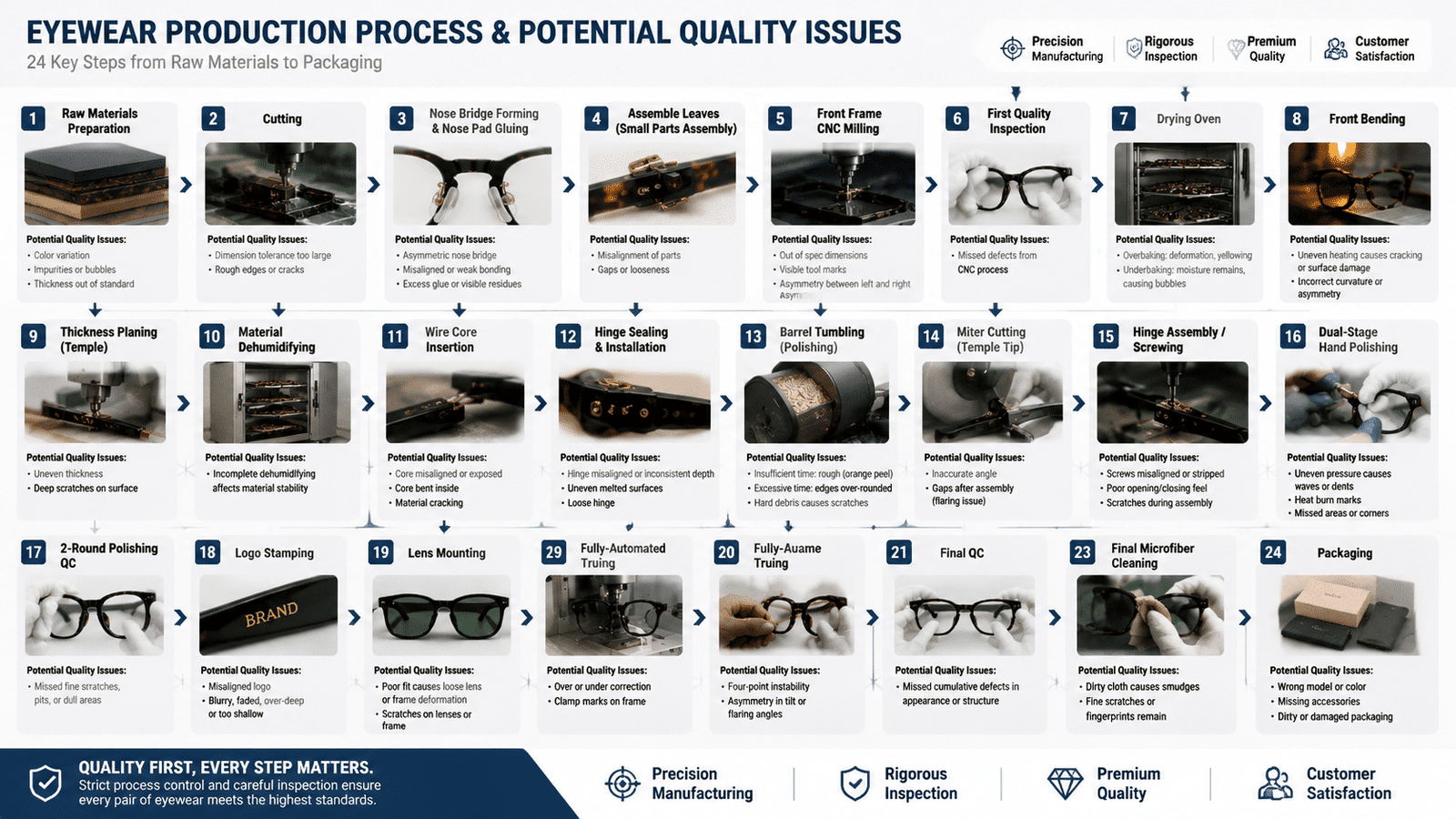
When B2B buyers place a private label or OEM order, one of the most common questions is: “Why does the acetate eyewear manufacturing process take 75 to 90 days?” Unlike injection-molded plastic frames that are mass-produced in seconds, authentic acetate production is a hybrid of precision CNC machining and extensive hand-crafting. To help brand owners and sourcing managers understand the production timeline, we have deconstructed the entire manufacturing workflow into 24 exact steps.
At Jion Eyewear, our goal goes beyond just manufacturing frames. We analyze your local market, provide region-specific hot-selling designs, and help you scale into a mature brand. Understanding how your product is made—and the specific quality risks we control at each stage—is the first step in that partnership.
Phase 1: Material Preparation & Initial Shaping
The foundation of a durable frame relies on stable materials and accurate initial cutting.
1. Raw Material Preparation We source high-grade acetate from suppliers like Mazzucchelli, Jimei, Jinyu, and Zhongao. These materials are chosen for their structural stability, high polish texture, and resistance to fading over long-term wear. QC Focus: We reject sheets with color deviations, internal impurities, bubbles, or substandard thickness.
2. Acetate Cutting The raw sheets are cut into manageable blocks for the front frames and temples. QC Focus: Cutting size errors can leave insufficient material for CNC machining. We monitor for rough edges or micro-cracks.
3. Nose Bridge Forming & Nose Pad Gluing The bridge is pressed into shape, and acetate nose pads are manually bonded. QC Focus: Asymmetrical bridge pressing, off-center pad placement, weak adhesion, or visible glue overflow will cause fit and aesthetic issues later.
4. Small Parts Assembly Assembling the initial structural inserts and components. QC Focus: Misalignment or gaps during assembly lead to loose components.
5. Front Frame CNC Milling The precise shape of the front frame is carved using automated CNC routers. QC Focus: If milling dimensions deviate from the CAD drawing, the frame shape will be asymmetric. Improper blade settings can also leave deep machine marks on the surface.
6. First Quality Inspection A dedicated QC checkpoint before the frames move to thermal processing. QC Focus: Preventing any semi-finished frames with CNC defects from moving to the next stage.
Phase 2: Thermal Processing & Conditioning
Acetate is a natural cotton-based plastic. It must be heated, dried, and dehumidified carefully to prevent shrinking or warping during retail display.
7. Drying Oven Frames are baked to remove internal moisture. QC Focus: If temperatures are too high or bake times too long, the acetate deforms and yellows. If baked too little, residual moisture causes the material to bubble during later steps.
8. Front Bending The flat CNC-cut frame is heated and bent to achieve the correct base curve (face wrap). QC Focus: Uneven heating causes the acetate to snap or form surface cracks. We ensure the left and right curvatures are perfectly symmetrical.
9. Temple Thickness Planing Temples are planed down to the exact millimeter required for comfortable flexibility behind the ear. QC Focus: Uneven planing thickness or deep machine scratches that are difficult to polish out later.
10. Material Dehumidifying A final moisture-removal stage for the temples before inserting metal cores. QC Focus: Incomplete dehumidification affects material stability, causing the temple to warp after the core wire is inserted.
Phase 3: Core Wires & Hinge Construction
This phase gives the frame its mechanical strength and smooth folding action.
11. Wire Core Insertion (Shooting) Heated metal cores are forcefully injected into the acetate temples. QC Focus: Misaligned injection leads to exposed wires, bent cores inside the temple, or bursting the acetate entirely.
12. Hinge Sealing & Installation Metal hinges are melted and pressed securely into the front frame and temples. QC Focus: Crooked insertion, uneven depth, or melted acetate around the hinge area. Loose hinges result in returns from retail customers.
13. Barrel Tumbling Frames tumble in wooden barrels with wood pegs and polishing pastes for several days to smooth rough machine edges. QC Focus: Insufficient tumbling leaves a rough “orange peel” texture. Over-tumbling destroys the sharp, intentional design angles of the frame. Impurities in the barrel can cause deep scratches.
14. Miter Cutting Cutting the precise angle where the front frame meets the temple. QC Focus: Inaccurate cutting angles result in visible gaps between the front and the temple, or improper temple opening angles (pantoscopic tilt issues).
15. Hinge Assembly & Screwing Attaching the temples to the front frame. QC Focus: Stripped or crooked screws, tools scratching the frame, or hinges that feel too stiff or too loose when opening.
Phase 4: Final Finishing & Detailing
The final week of production focuses heavily on hand-craftsmanship and aesthetic perfection.
16. Dual-Stage Hand Polishing Skilled workers use polishing wheels and wax to achieve a high-gloss finish. QC Focus: Uneven hand pressure causes wavy surfaces. Friction-induced heat can burn the acetate, and hard-to-reach corners can be missed entirely.
17. Two-Round Polishing QC A visual inspection under bright lights. QC Focus: Catching any microscopic scratches, sandholes, or dull areas left behind by the polishing wheels.
18. Logo Stamping Foil stamping or laser engraving the brand logo onto the temples or lenses. QC Focus: Off-center logos, incorrect temperature/pressure causing blurred or faded lettering, or pressing too deeply into the acetate.
19. Lens Mounting Inserting the demo lenses, sun lenses, or polarized lenses into the frame groove. QC Focus: If frame sizes and lens cuts do not perfectly match, lenses will easily pop out, or the pressure will deform the frame. Careless insertion can scratch the frame or lens.
20. Fully-Automated Frame Truing Machines apply gentle heat and pressure to ensure the frame sits squarely. QC Focus: Machine parameter errors causing over-correction, or mechanical clamps leaving indentations on the polished acetate.
21. Manual Frame Truing Experienced technicians manually adjust the frame on a flat glass table. QC Focus: Ensuring a perfect 4-point alignment (both temples and both eye wires touch the table evenly). Eliminating asymmetric tilt or outward bowing.
Phase 5: Final Inspection & Logistics
22. Final Quality Control (QC) The last line of defense before the product reaches the buyer. QC Focus: Catching any accumulated visual defects, structural issues, or mechanical flaws from previous steps.
23. Final Microfiber Cleaning Wiping down the frames to remove all factory dust and fingerprints. QC Focus: Using dirty cleaning cloths can actually spread grime or leave invisible micro-scratches on the lenses.
24. Packaging Placing the eyewear into polybags, cases, and master cartons. QC Focus: Mixing up styles or colors, forgetting accessories (cleaning cloths, manuals), or using damaged outer boxes.
Why We Share This With You: The Jion Eyewear Approach
The 75 to 90 days required for this process is exactly what separates high-end retail eyewear from cheap promotional goods. Rushing the curing or polishing stages directly leads to warped frames and retail returns.
At Jion Eyewear, our business model is built on partnership. We do not just process orders; we help you analyze your regional market data. By recommending frame shapes, colors, and lens functions that are proven to sell in your specific demographic, we lower your inventory risk. We manage these 24 complex manufacturing steps so you can focus entirely on marketing and growing your brand.
Quick Buyer Decision Guide
Best for: Brand owners, optical retailers, and wholesale distributors looking for durable, high-margin, retail-ready eyewear.
Not ideal for: Buyers needing ultra-cheap, disposable promotional sunglasses delivered in 15 days.
MOQ consideration: Because acetate production requires extensive setup for cutting, baking, and tumbling, OEM factory runs typically require higher MOQs per color than stock injection-molded plastics.
Customization potential: High. Acetate allows for rich color variations (tortoise, laminations, gradients), custom core wire designs, custom miter angles, and precise logo stamping.
Key point to confirm before ordering: Confirm your target delivery date early. Because standard acetate production takes 75-90 days, seasonal inventory (like summer sunglasses) should be ordered 4 to 5 months in advance to allow for shipping and customs clearance.
Start Your Eyewear Project Today
Ready to build a collection that fits your local market? Send us your target market, brand positioning, and logo file. Our team will recommend suitable acetate materials, provide hot-selling style references for your region, and map out a clear production timeline for your first order.